How to choose luxury home theater seating
By Adam Zell, Boston Automations | Published | Updated | 8 minute read
The short answer
How do you choose luxury home theater seating?
Start with how people will sit: upright for films, stretched out for sports, curled up with kids. Then match the seat type (individual recliners, modular sofas, chaises or swivel chairs) to the room width and riser depth, choose the motion (two-motor or three-motor with an adjustable headrest), and pick upholstery that suits how hard the room will be used.
How your family sits
Seating is the part of a theater you touch for every minute of every film, so it is worth starting with people rather than products. Think about who will be in the room most often and how they like to sit. Some people sit upright and still for a three hour epic. Others put their feet up and lie almost flat for football. Kids pile onto whatever is closest. Guests want to talk before the movie starts.
Write down the most common night in the room, and the biggest night, such as a holiday or a playoff game. The common night decides the seats you will love. The biggest night decides how many you need.
The four types of seating
| Type | Best for | CinemaTech examples |
|---|---|---|
| Theater recliners | Dedicated cinemas with tiered rows and individual control | Valentino, Sevilla, Bordeaux |
| Sofas and sectionals | Front rows, family theaters and media rooms | Hudson, Montecito, Greenwich |
| CinemaTech Living | Rooms that host reading, music and conversation as often as films | Arezzo, Lugano, Stellina |
| Swivel chairs | Lounges, libraries and theater corners | Noir, Seraphina |
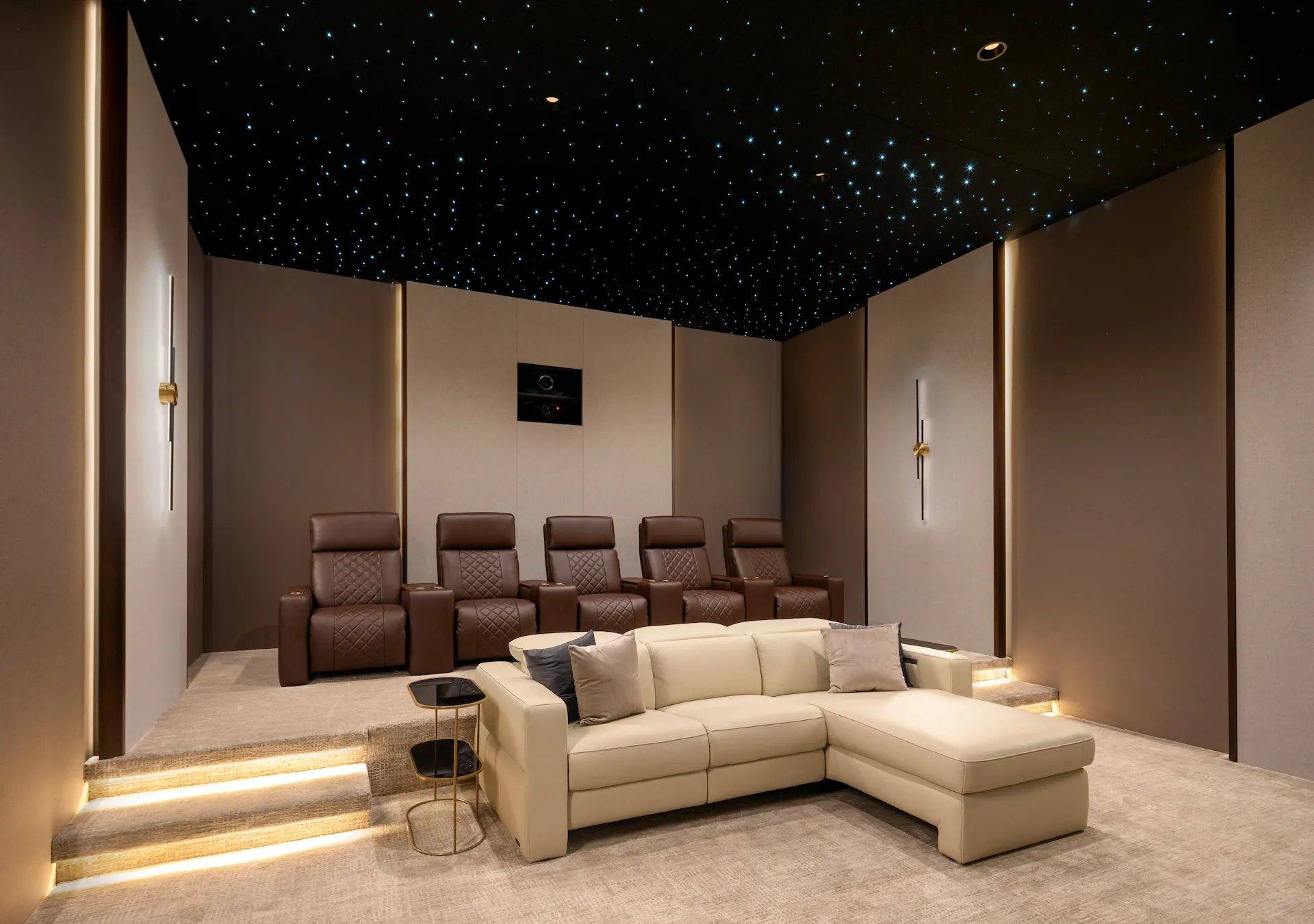
Mixing types is common and often looks best. A low sofa or chaise in the front row keeps the view open for the rows behind, while recliners on the risers give each person their own space. Pairing related models, such as Estrella in front with Estrella High Back behind, keeps the room looking like one collection.
Motors and motion
Motion is where luxury seating separates itself from furniture. CinemaTech's U.S.-built seats generally use a two-motor mechanism that moves the back and the footrest. Most of its German-engineered models use three motors, which add independent control of the headrest so you can lie back and still look straight at the screen.
Newer models go further. The CinemaTech Living seats add personal position memory, a one-button return to upright and integrated USB-C charging, and Arezzo has an elevating backrest that rises from a low lounge profile into full support. Swivel chairs such as Noir can run on battery power, which helps in rooms where running power to the seat is hard.
Plan the power for motorized seats during construction. Each seat or group needs an outlet under the riser or floor, which is far easier to run before the carpet goes down.
Fitting the room
The room decides more of the seating than people expect. Row width sets how many seats fit across, and arm width matters as much as seat width. Sevilla, with 6.5 inch arms, fits more seats across a row than a model with wide sculpted arms like Montecito, which has 9 inch arms. Recline depth sets how far apart the rows must be. Lugano reaches 68 inches fully inclined, so the row behind it needs that space plus a walkway.
Height matters for sightlines. A low seat in the front row, such as Estrella at 30 inches tall or Montecito at 37 inches, lets the second row see over it with a smaller riser. A tall high back seat in the front row needs more riser behind it. Our room size guide explains how rows, risers and screen height work together.
Upholstery
Leather is classic in a dedicated theater. It wears well, wipes clean and looks richer over time. Fabrics and velvets are softer and quieter, and they absorb a little sound rather than reflecting it, which is a small bonus in a theater. Performance fabrics are the right call for rooms with children, pets or a bar.
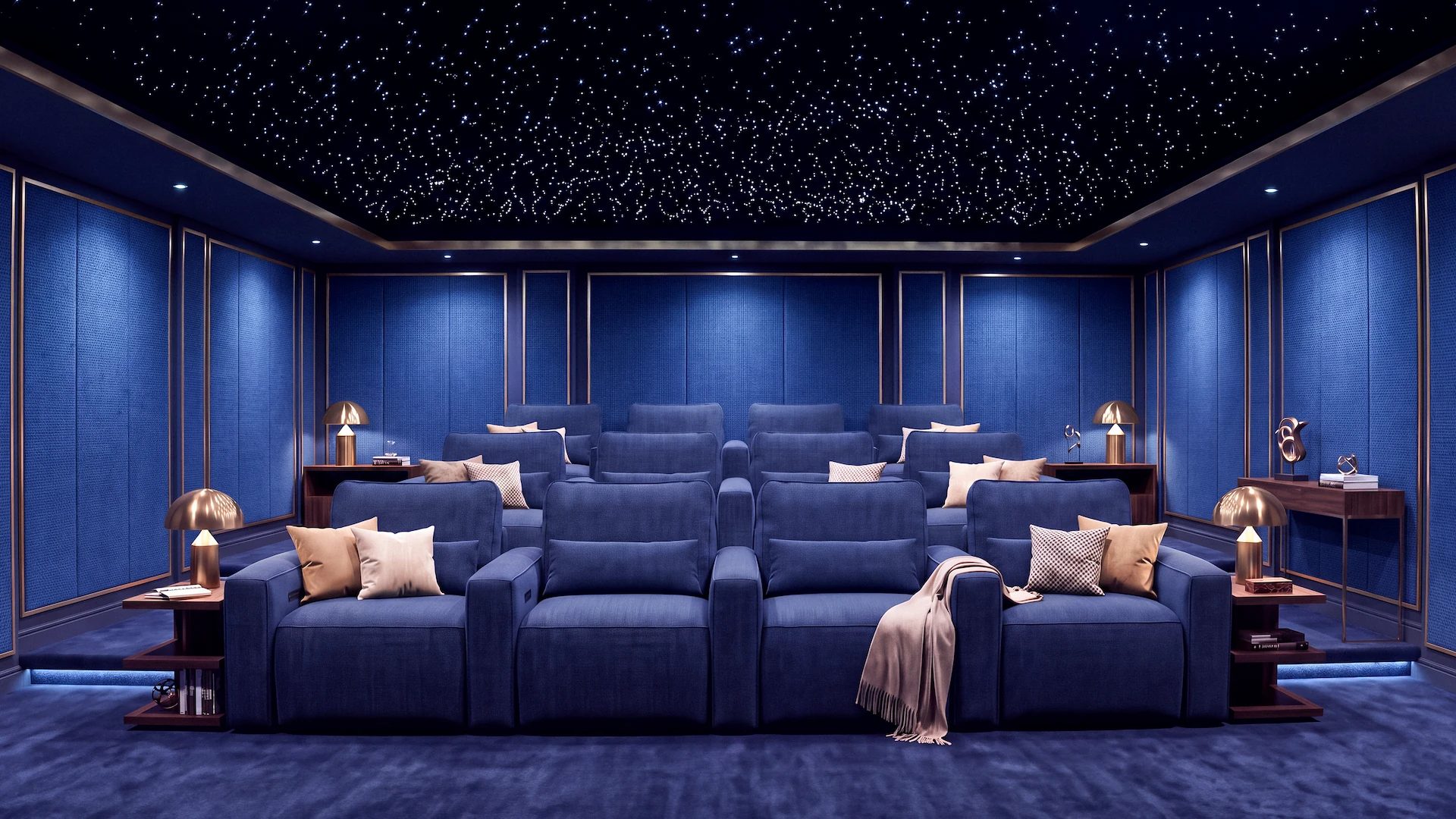
Color matters for the picture too. Light colored seats near the screen reflect light back onto it and can lift the black level in a dark theater. Deep tones keep the room disappearing when the film starts. In a media room with daylight, lighter seating is usually fine.
Details that matter
- Cup holders in silver, bronze or black, or none at all for a cleaner arm.
- Backlit seat switches with USB-C, so controls are easy to find in the dark.
- Center consoles with storage, as on Sevilla, for remotes, blankets and glasses.
- Tables and trays that swing over the arm for dinner and drinks.
- Stitching details, such as diamond quilting or channel tufting, that suit the room's style.
Front row, back row
Each row in a theater has a different job, and the best rooms choose seating row by row. The front row is closest to the screen and lowest in the room, so it is the natural place for a sofa, a chaise or a pair of loungers. A low profile there keeps the view open for everyone behind. It is also where kids like to sprawl, so durable fabric and a deep seat pay off.
The middle row is usually the prime row, set at the ideal distance for the screen and the speakers. Owners often sit here, so it deserves the most adjustable seats, with three motors and a headrest that lets you lie back and still see the whole image.
The back row sits highest on the riser, often in front of a bar counter or a walkway. Taller backs like Hudson High Back or Estrella High Back give real head support and frame the room nicely from the entrance. In rooms with many seats, a performance model such as M3, offered only in top grain black leather, is a sensible way to fill extra positions.
Comfort over years
A theater seat is used for hours at a time, many times a week, for years. That is why construction matters as much as looks. Cushioning that keeps its shape, mechanisms that move quietly and frames built to order all show up after the third year, not the first night. CinemaTech's NanoSoft three-layer comfort in the Living collection and Montecito is designed for exactly that kind of long use. Ask about the warranty on frames, mechanisms and upholstery for any model you are considering, and plan to keep the room conditioned so leather and fabric stay in good shape through New England winters and humid summers.
Trying before you buy
Seating is personal, so we encourage clients to sit in it. We review CinemaTech fabric and leather samples with you, and CinemaTech's showrooms in Los Angeles, Dallas, Miami and New York let you try models in finished theaters. CinemaTech offers up to a $1,000 travel credit toward qualifying seating or acoustics purchases of $50,000 or more for clients who visit. Browse the full CinemaTech seating collection, then talk with us about the room it will live in.
More questions
Are recliners or sofas better for a home theater?
Individual recliners are better when everyone wants their own position and the room has several tiered rows. Sofas and sectionals are better for families, couples and rooms that also host conversation. Many theaters use a sofa or chaise in the front row and recliners behind it.
What does three-motor mean on a theater seat?
A three-motor seat moves the headrest, the backrest and the footrest independently, so each person can find their exact position. Two-motor seats move the back and footrest. CinemaTech's German-built models such as Bordeaux, Montecito and the CinemaTech Living seats use three motors.
Can I use my own fabric on CinemaTech seating?
Yes. Many CinemaTech models accept customer's own material or leather, known as COM and COL, in addition to CinemaTech's own fabric and leather collections. Your interior designer can specify a fabric that matches the rest of the house.
How long does custom theater seating take?
CinemaTech seating is built to order after the configuration and upholstery are final, so it is scheduled into the overall project timeline. We order it as soon as selections are approved so it arrives ahead of installation.