Dolby Atmos speaker layouts for a private cinema
By Adam Zell, Boston Automations | Published | Updated | 7 minute read
The short answer
What is the best Dolby Atmos layout for a home theater?
For most dedicated theaters, 7.2.4 is the starting point: three front speakers, four surrounds, two subwoofers and four overhead speakers. Larger rooms with two or three rows benefit from 9.4.6, which adds front wide speakers, more subwoofers for even bass across every seat, and six overhead speakers so height effects stay precise.
What the numbers mean
Dolby Atmos layouts are written as three numbers. The first is the count of speakers at ear level around the room. The second is the number of subwoofers. The third is the number of overhead, or height, speakers. So 7.2.4 means seven ear level speakers, two subwoofers and four overhead speakers. DTS:X and other immersive formats use the same kind of layout, so a well designed Atmos room plays them all.
Common layouts
| Layout | Ear level speakers | Typical room |
|---|---|---|
| 5.1.2 | Left, center, right, two surrounds | Media rooms and compact single row spaces |
| 7.2.4 | Adds two rear surrounds | Most dedicated theaters with one or two rows |
| 9.4.6 | Adds front wide speakers | Larger two and three row cinemas |
| Larger arrays | Multiple surrounds per side and more overheads | Reference cinemas with many seats |
More channels are not automatically better. The goal is that every seat, not just the center one, hears effects placed correctly and dialogue anchored to the screen. A bigger room with more rows needs more speakers to cover it evenly. A small room with too many speakers gains little. Match the layout to the seating plan.
The screen wall
The left, center and right speakers do most of the work in any film, carrying dialogue and most of the score. In a private cinema they sit behind an acoustically transparent screen, at about ear height, with the center aimed at the main row. Matching all three speakers is important, so a voice that moves across the screen keeps the same tone.
Front wide speakers in a 9.4.6 layout sit between the front speakers and the side surrounds. They fill the gap as sounds sweep from the screen into the room, which matters most in wide rooms.
Surrounds and rows
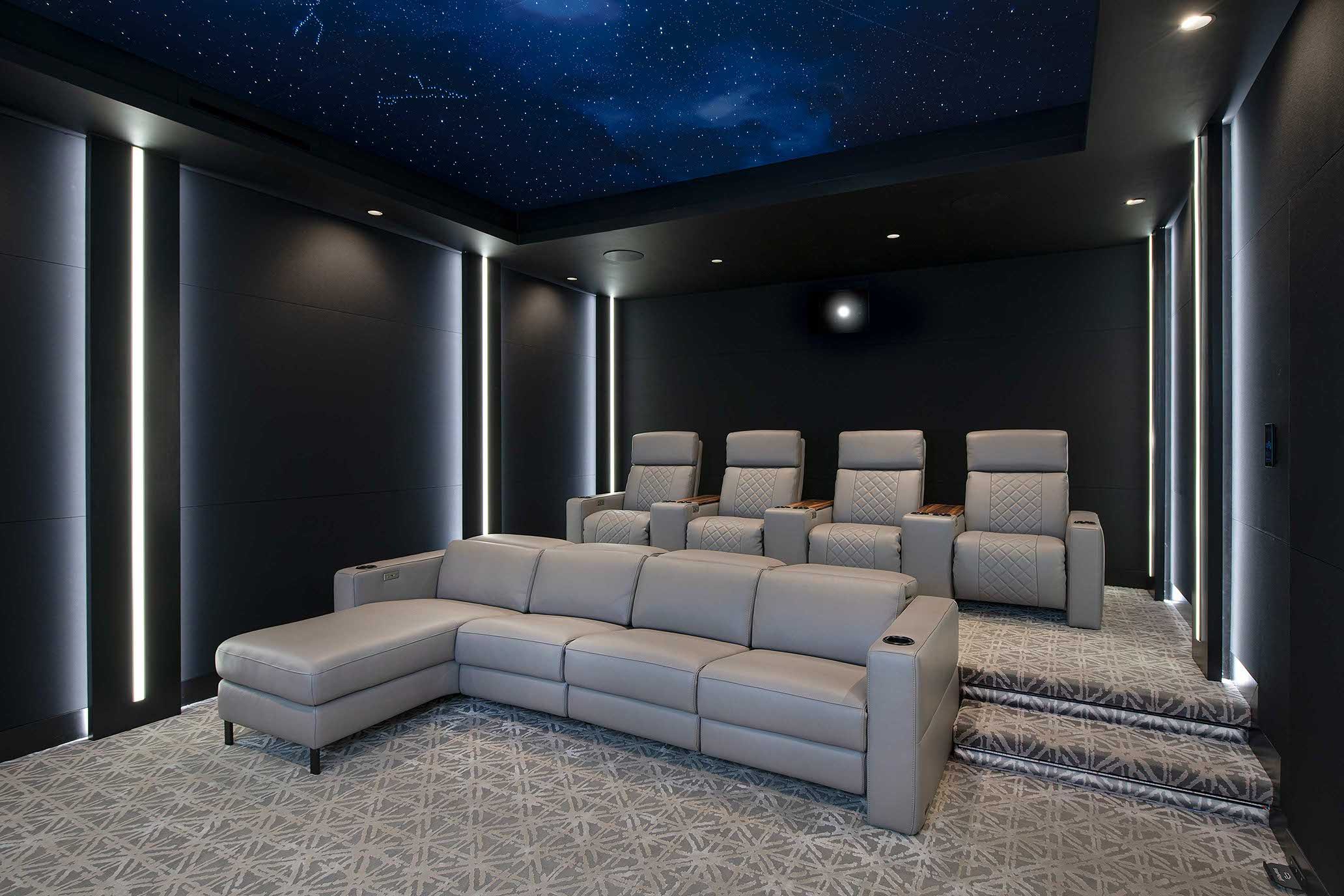
Dolby's guidelines place side surrounds slightly behind the main listening position and rear surrounds behind the last row. With two or three rows, a single pair of side surrounds is too close to some seats and too far from others, so larger rooms often use more than one pair per side. Surrounds are usually mounted a little above ear height so the back rows on risers are not blocked by heads in front.
This is why speaker layout follows seating, not the other way around. CinemaTech's drawings set the rows and risers, and the speaker positions are planned from them. Our room size guide explains rows and risers.
Overhead speakers
Overhead speakers give Atmos its sense of height: rain on the roof, a helicopter passing over, a score that seems to fill the air. Four overheads usually sit in two pairs, one slightly in front of the main row and one slightly behind. Six overheads add a middle pair for larger rooms.
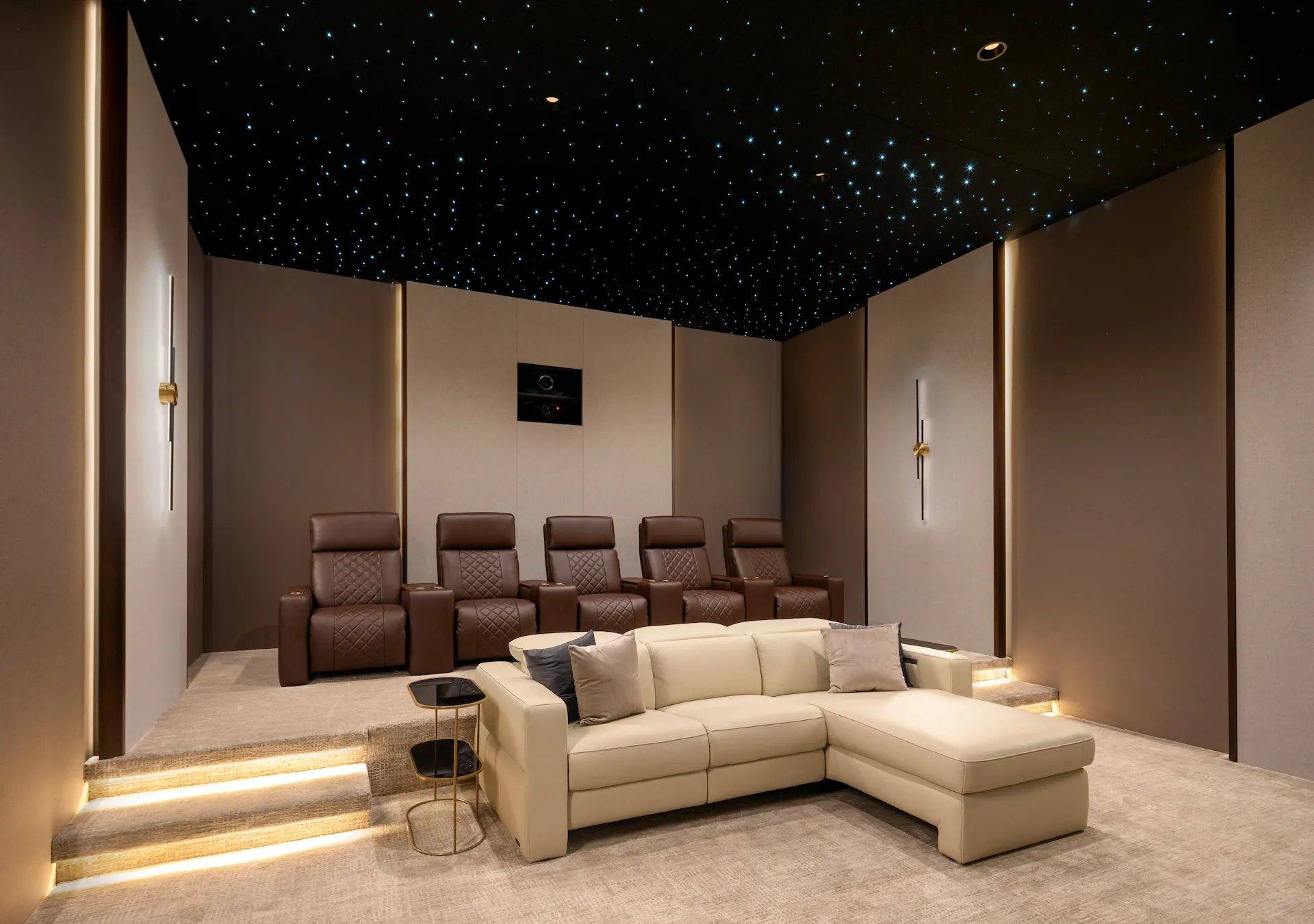
Ceiling height affects placement. In a low room, overheads end up close to the heads of people on the top riser, so we may angle them or adjust the positions. In a room with a star ceiling, speaker locations are planned with the fiber layout so neither interferes with the other. See our star ceiling guide.
Subwoofers and bass
Bass is the hardest part of any theater. Low frequencies are long waves that bounce around the room and pile up in some seats and cancel in others. One subwoofer can sound huge in one seat and thin two seats over.
The fix is more subwoofers in carefully chosen positions, often at the front and the midpoints of the walls, which is why larger rooms move from two subwoofers to four. Combined with acoustic treatment and room correction, multiple subwoofers give tight, even bass in every row. Learn how treatment helps on our acoustics page and in acoustics versus soundproofing.
Hiding the speakers
In a luxury theater you should hear every speaker and see none of them. Behind the screen, the front speakers sit in a black, acoustically dead cavity so the screen itself is the only thing visible. Around the room, surrounds and overheads are built into the walls and ceiling behind acoustically transparent fabric. With CinemaTech's Acoustic Room System, the speakers are mounted inside the fabric framework and the absorption and diffusion panels are laid out around them.
That means speaker positions, treatment and fabric seams are planned together in the drawings. Sconces, light lines and fabric panel joints are arranged so nothing sits in front of a speaker, and so the walls look symmetrical even when the speakers are not perfectly evenly spaced.
Atmos in a media room
A media room can still deliver real Atmos. In-ceiling speakers handle the height channels, in-wall speakers cover the front and surrounds, and one or two subwoofers sit in cabinetry or behind grilles. Open floor plans, windows and hard surfaces make it harder to get a precise effect, so we focus on clear dialogue and well placed overheads for the main seating area. A 5.1.2 or 7.2.4 layout usually fits a family room well. Our home theater versus media room guide covers the rest of the trade-offs.
Processing and calibration
A high channel count system needs a processor that decodes Atmos and DTS:X and manages room correction, plus enough amplifier channels to drive every speaker with headroom. The final step is calibration. We set levels, distances, crossovers and equalization for the room with measurement microphones across the seating area, not just the center seat.
Calibration is what turns a room full of good speakers into a cinema. Learn more on our technology page, or start a conversation about your room.
More questions
Is 5.1.2 enough for a home theater?
It works well in a media room or a small single row space, where two overhead speakers add a real sense of height. In a dedicated cinema with more than one row, 7.2.4 is a better starting point so every seat gets accurate surround and overhead effects.
Do Atmos up-firing speakers work in a private theater?
They are a compromise for rooms where in-ceiling speakers are not possible. In a dedicated theater with an acoustically treated ceiling, true overhead speakers installed in the ceiling give far more precise height effects.
Can speakers be hidden completely?
Yes. In a dedicated theater the front speakers sit behind an acoustically transparent screen and the surrounds and overheads sit behind acoustic fabric, so nothing is visible. In media rooms, in-wall and in-ceiling speakers can be painted or covered to disappear.