Projector and screen or a big TV: which belongs in your theater?
By Adam Zell, Boston Automations | Published | Updated | 7 minute read
The short answer
Should a home theater use a projector or a TV?
In a dedicated, light controlled theater, a 4K laser projector with an acoustically transparent screen is usually the better choice, because it gives a much larger image and lets the speakers hide behind the screen. In a bright media room, a large TV, a direct-view LED wall or a projector with an ambient light rejecting screen handles daylight better.
The four options
There are four ways to put a big image in a luxury room, and each one suits a different kind of space.
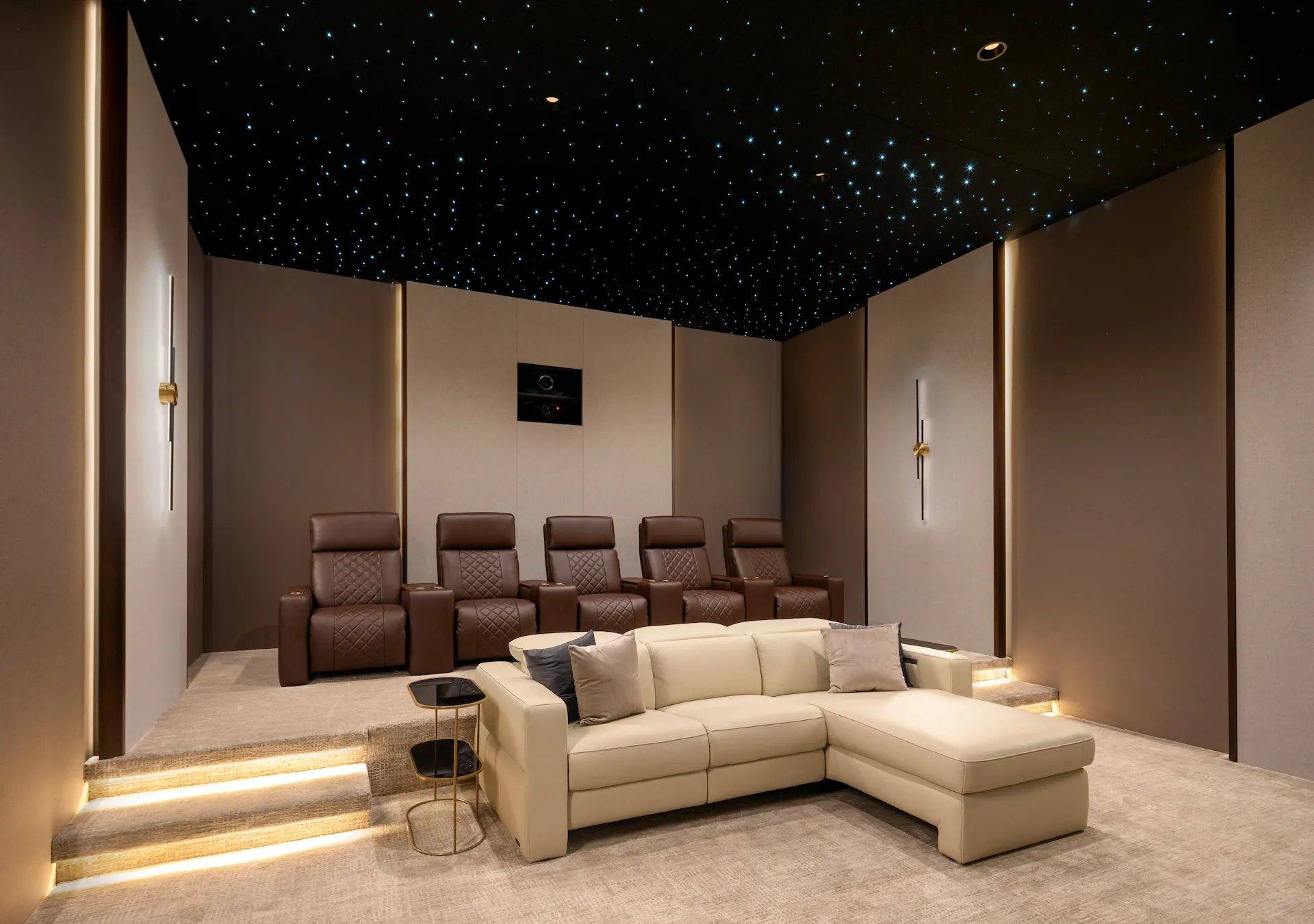
- Projector and acoustically transparent screen. The classic private cinema. A 4K laser projector, usually in a rear soffit or hush box, fills a large screen that the front speakers hide behind.
- Projector and ambient light rejecting screen. A projector paired with an optical screen that rejects light from above and the sides, for rooms that cannot be fully darkened.
- Large flat panel. An 85 to 115 inch OLED or LCD television. Bright, simple and excellent in daylight.
- Direct-view LED wall. Modular LED panels that build a screen of almost any size with very high brightness. Spectacular and the most expensive way to get a large bright image.
Side by side
| Option | Typical size | Best room | Speakers behind image |
|---|---|---|---|
| Projector and AT screen | 120 to 200 in | Dedicated, dark theater | Yes |
| Projector and ALR screen | 100 to 150 in | Media room with some light | Usually no |
| Large flat panel | 85 to 115 in | Bright media or family room | No |
| Direct-view LED wall | 130 in and up | Any room, including bright ones | No |
Size and immersion
A cinema feels like a cinema because the image fills your field of view. Industry guidance from SMPTE and THX suggests a viewing angle of 30 to 40 degrees, and many private theater owners prefer 45 degrees or more from the main row. From 13 feet away, 40 to 50 degrees means a 16:9 screen of roughly 130 to 165 inches diagonal. The largest televisions stop well short of that. Projection reaches it for a fraction of what an LED wall of the same size costs.
In a smaller room, a large flat panel can deliver a similar viewing angle from closer seats, which is why many media rooms are built around one. Our room size guide shows how distance and screen size work together.
Brightness and ambient light
A projector cannot produce black. The darkest part of the image is whatever light is already on the screen. In a room with dark walls, ceiling and seating and no windows, that is almost nothing, and the projected image looks deep and cinematic. Add a lamp or a window and the blacks turn gray.
That is why the room and the screen are designed together. In a dedicated theater, we specify dark, matte finishes around the screen and a lighting design that dims fully. In a media room, motorized shades handle evenings, and an ambient light rejecting screen, a large display or an LED wall handles daytime.
Where the speakers go
With an acoustically transparent screen, the left, center and right speakers sit directly behind the image at ear height, so voices come from the actors. The screen wall becomes a clean surface with nothing to see but the picture. This is one of the strongest reasons to choose projection in a dedicated room.
With a television or an LED wall, the speakers go above, below or beside the image, or in the wall around it. Good in-wall speakers and careful placement get very close, but the center channel is never quite as convincing. Learn more about speaker placement in our Dolby Atmos layout guide.
Screen shape and masking
Most films are wider than a television, at 2.39:1 rather than 16:9. On a 16:9 screen they show black bars top and bottom. Many private cinemas use a 2.35 or 2.40 wide screen so films fill it edge to edge, with lens memory on the projector to show 16:9 content in the center. Motorized masking panels can then frame each format with black borders, which makes the image look sharper and brighter. A good integrator calibrates each of these modes so switching between them is one button.
Projector placement and noise
Where the projector lives shapes the room. Most private cinemas place it at the back, either on a ceiling mount above the last row, in a soffit or in a hush box that hides it and quiets its fans. The distance from the lens to the screen, called the throw, sets how big the image can be, so the projector, screen size and back wall are planned together. Lens shift lets the projector sit off center or high on the wall without distorting the image.
The projector also needs a clear path over the heads of the back row and a way to shed heat. A hush box needs ventilation, and the HVAC should keep it cool without blowing on the seats. Some rooms place the projector in an adjoining equipment room and shoot through a glass port, which keeps it completely silent and out of sight.
HDR, contrast and the picture you see
High dynamic range, or HDR, lets bright highlights shine while shadows stay dark. Televisions and LED walls can reach very high peak brightness, which makes HDR pop. Projectors are dimmer, so they rely on contrast, tone mapping and a dark room to show HDR well. In a properly designed theater with a high quality laser projector, the result is a natural, film-like image that many people prefer to the punch of a bright flat panel.
Screen gain, color and texture affect this too. A neutral gray or white screen matched to the projector's brightness and the room's darkness gives the best balance. Calibration after installation sets color, gamma and HDR tone mapping for the specific projector, screen and room.
How we help you choose
The answer depends on the room, how often it is bright, and how you watch. In practice, dedicated cinemas almost always get a 4K laser projector and acoustically transparent screen, and media rooms get a large display or a projector with an ambient light rejecting screen. Some homes use both, with a drop-down screen in front of a television for movie nights.
We design the picture with the rest of the room: sightlines, screen height, projector throw, speakers and lighting. See the technology page for the brands and systems we work with, or tell us about your room.
More questions
Is a laser projector better than a lamp projector?
For a private cinema, generally yes. Laser light sources hold their brightness and color for many thousands of hours without lamp changes, turn on instantly and usually deliver better contrast. Nearly every new premium home cinema projector now uses a laser.
What is an acoustically transparent screen?
It is a screen surface woven or perforated so sound passes through it. The left, center and right speakers sit behind the image, so dialogue comes from the faces on screen, just as it does in a commercial cinema.
Can a projector work in a room with windows?
Yes, with motorized blackout shades for movie nights, or with an ambient light rejecting screen that bounces projector light toward the seats and away from window light. Even so, a large display usually handles bright daytime viewing better.