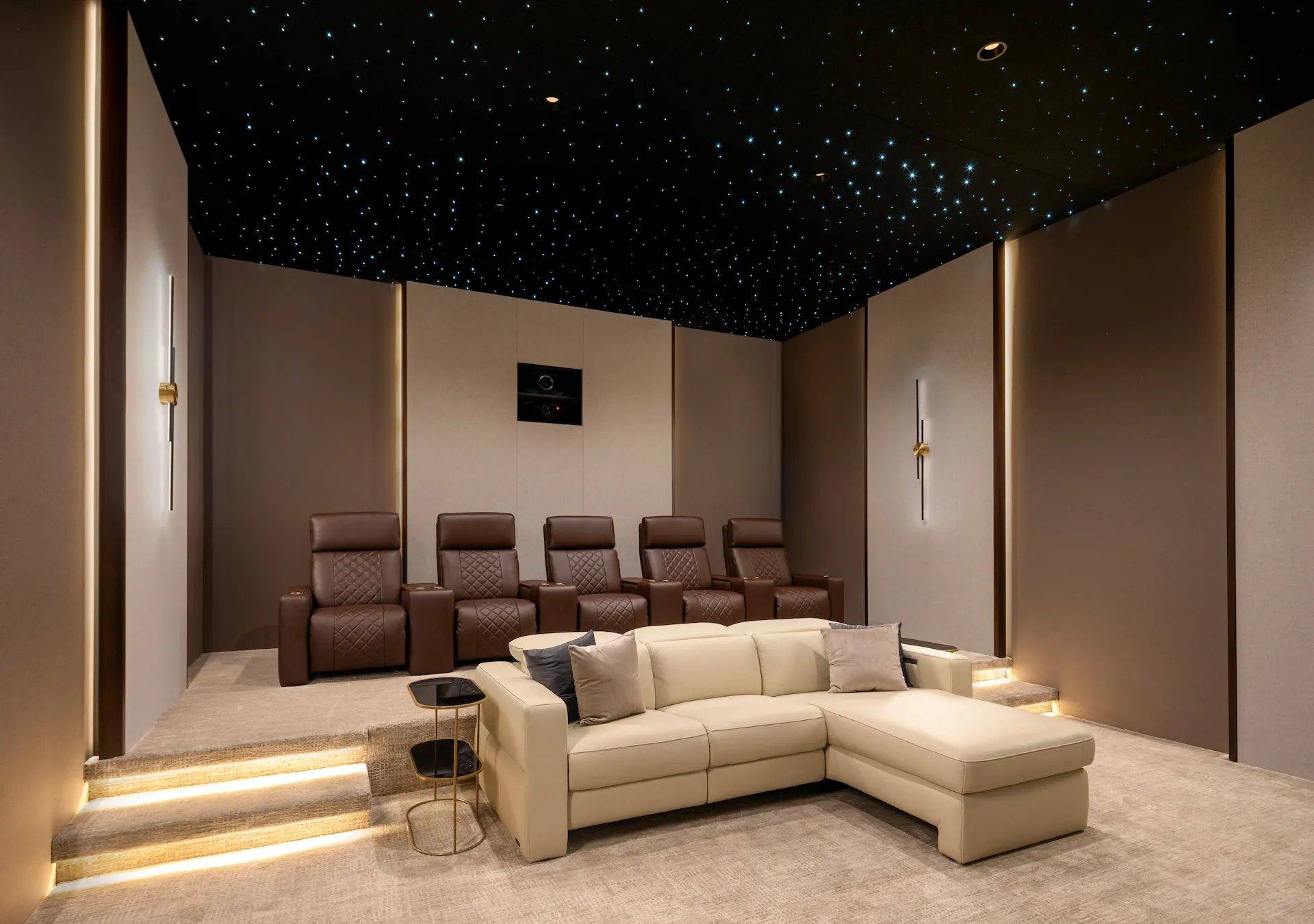
How to choose a home theater designer and installer
By Adam Zell, Boston Automations | Published | Updated | 6 minute read
The short answer
What should you look for in a home theater designer?
Look for a team that produces real drawings (floor plans, elevations, ceiling plans and sightline studies), designs acoustics for your specific room, offers seating built to order, coordinates with your architect and builder, calibrates the finished system and supports it for years. Ask to see sample drawings and renderings, not just photos of finished rooms.
What a theater designer does
A luxury theater is part architecture, part furniture and part technology. The designer's job is to make all three agree. That means planning the seating layout and riser heights so every seat has a clear view, sizing the screen for the seating distance, laying out speakers for the room and the rows, designing acoustic treatment for the actual dimensions, and choosing materials and lighting that look right in your home.
It also means coordination. Your architect, builder, electrician, HVAC contractor and interior designer all touch the theater. Someone has to give them clear drawings and answer their questions. If nobody owns that role, the theater gets designed by whoever happens to be on site that day.
Ask to see drawings
Photos of finished rooms show taste. Drawings show competence. Before you hire anyone, ask to see sample deliverables from a real project. A serious theater design package usually includes:
| Deliverable | What it tells you |
|---|---|
| Floor plan and seating layout | Seat sizes, row spacing, riser depths, walkways and speaker positions |
| Reflected ceiling plan | Lights, speakers, HVAC, projector and any star ceiling, all coordinated |
| Wall elevations | Fabric panel layout, sconces, doors, screen wall and finish legend |
| Sightline and viewing angle studies | Proof that the back row can see over the front row |
| Acoustic plan | Where absorption and diffusion go and why |
| Photorealistic renderings | What the room will look and feel like before it is built |
You can see examples of CinemaTech's preliminary drawings and renderings on our Design Services Program page.
Questions to ask
- Who on your team draws the room, and can I see drawings from a past project?
- How do you design acoustics for this specific room, and what do you install?
- Where does the seating come from, and can I try it before ordering?
- How will you coordinate with my architect, builder and interior designer?
- What is your scope, and what is the builder's scope?
- Do you calibrate the projector and sound system after installation?
- Who do I call in two years when something needs attention?
- Will the theater work with the lighting and control in the rest of my home?
Red flags
- An equipment list and a price with no drawings of the room.
- Acoustic treatment described only as a number of panels, without a plan for where they go.
- Seating chosen from a catalog photo with no thought to riser depth or recline clearance.
- No mention of isolation when the theater sits under bedrooms or living space.
- No calibration step, or calibration described as running an automatic setup once.
- Vague answers about who handles service after the install.
Try the seating first
Seating is the part of the theater you touch every time you use it, and it is the hardest to change later. A good designer will plan the room around the seats, not the other way around, and will make sure you can feel the options before anything is ordered.
With CinemaTech, every seat is built to order, so the choices are wide: individual recliners like the Valentino, modular sofas like Greenwich and Montclair, the motorized CinemaTech Living models, and swivel chairs. Widths, motors, chaises and upholstery all vary. We review fabric and leather samples with you, and CinemaTech's travel credit can help with a visit to one of its showrooms in Los Angeles, Dallas, Miami or New York.
Whoever you hire, ask how the seat sizes on the drawing were chosen. The answer should mention recline clearance, riser depth, arm widths and walkway space, not just how many seats fit. Our seating guide explains what to look for.
Talking about budget
A good designer will talk about money early and plainly. Not with a final price on the first call, because nobody can price a room they have not drawn, but with honest planning ranges and a clear view of what drives them. Seating count and upholstery, screen size and projector, speaker count, acoustic wall area and lighting all move the number.
Ask the designer to separate their scope from the builder's. Construction items like framing, isolation, risers, HVAC and electrical are priced by your builder from the drawings. Seating, acoustics, technology and calibration are usually in the theater team's scope. When those lines are clear from the start, there are far fewer surprises later. Our cost guide shows how we break a theater budget down.
Calibration and service
A theater is only as good as its setup. After installation, the projector should be calibrated to the screen and the room's light, and the sound system should be measured and tuned at the seats so bass is even across rows and dialogue is clear. These steps take time and real measurement equipment, and they make a visible and audible difference.
Ongoing support matters too. Sources change, apps update and families find new ways to use the room. Ask how the designer supports the system remotely and how quickly they can visit.
How we work
Boston Home Cinema pairs two specialists. CinemaTech, a family-owned company designing theaters since 1998, leads the room design through its Design Services Program: consultation, AutoCAD floor plans, ceiling plans and elevations, sightline studies, finish selections and photorealistic 3D renderings. CinemaTech also handcrafts the seating and supplies its Acoustic Room System.
Boston Automations, winner of the 2024 Lutron Excellence Award and the 2024 Sonance and James Loudspeaker Project of the Year, handles the technology and the local work: equipment design, installation, lighting and control, calibration and long-term service across New England. You get one team from first sketch to opening night.
Read more about us, walk through our process, or tell us about your room.
More questions
Is a home theater designer the same as an AV installer?
Not always. An installer focuses on equipment. A theater designer plans the whole room: layout, seating, sightlines, acoustics, lighting and finishes, and coordinates the trades. The best results come from a team that does both.
Should the theater designer work with my interior designer?
Yes. The interior designer shapes the look of the home, and the theater designer makes sure the room performs. Good theater designers present materials and renderings that fit the interior designer's direction.
Do I pay for design before construction?
For a custom theater, design is usually its own phase. CinemaTech's Design Services Program produces drawings and renderings before seating and equipment are ordered, so everyone builds from the same plan.