Star ceilings: how a fiber optic sky is designed
By Adam Zell, Boston Automations | Published | Updated | 6 minute read
The short answer
How does a fiber optic star ceiling work in a home theater?
A star ceiling uses hundreds or thousands of fine optical fibers, fed from a light engine hidden outside the room, that end as points of light in an acoustic ceiling panel. The fibers carry light, not electricity, so the panels stay acoustically effective. A good design varies fiber sizes and density, adds slow twinkle, and dims fully when the film starts.
How it works
A fiber optic star ceiling has two parts. The first is a light engine, a small box with an LED source and a fan, that sits in a closet, attic or equipment room outside the theater. The second is a bundle of optical fibers that runs from the engine into the ceiling, where each fiber ends flush with the surface as a single point of light.
Because the fibers carry only light, nothing electrical lives in the ceiling itself. There is no heat at the stars, no buzzing, and nothing to fail above the seats. If the light source ever needs service, it is replaced in the closet, not in the ceiling.
Stars and acoustics together
In a well designed private cinema the ceiling is part of the acoustic system. First reflections from the ceiling blur dialogue, and the large flat area above the seats is a natural place for absorption. That is why the best star ceilings are built into acoustic panels rather than painted drywall.
The fibers are threaded through the acoustic panel and its fabric face, so the panel keeps working while it shows the stars. In a room using CinemaTech's Acoustic Room System, the ceiling can be planned with the same care as the walls, with absorption and diffusion placed where the acoustic model calls for them and the starfield laid out across the top.
Designing a convincing sky
The difference between a star ceiling that looks like a night sky and one that looks like a pegboard is in the design. A few things matter most:
- Varied fiber sizes. Real skies have a few bright stars and many faint ones. Mixing two or three fiber diameters creates depth.
- Natural density. Stars should cluster and thin out, never sit in rows. Denser areas toward the back and sides keep the area right above the screen calm.
- Slow twinkle. A subtle twinkle wheel or programmed shimmer brings the sky to life, but it should be slow enough that nobody notices it during a quiet scene.
- Color temperature. Slightly warm or neutral white looks more natural than a cold blue.
- Features with restraint. Shooting stars and constellations can be fun, especially in family rooms, but they belong on a scene the owner chooses, not on all the time.
Ceiling options compared
| Approach | Look | Acoustic value | Best for |
|---|---|---|---|
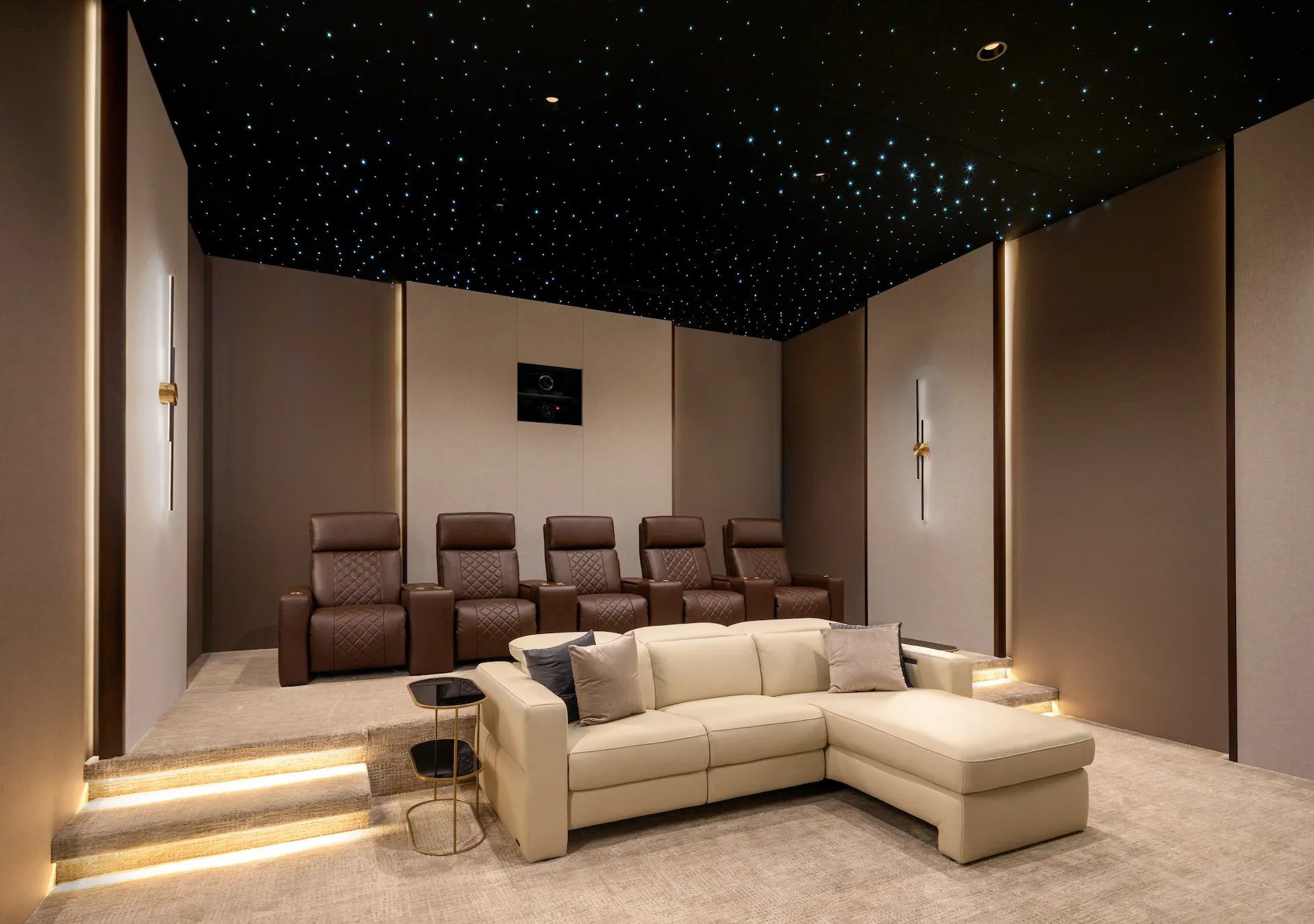
| Fiber stars in acoustic panels | Full night sky across the ceiling | High, the panels still absorb | Dedicated private cinemas |
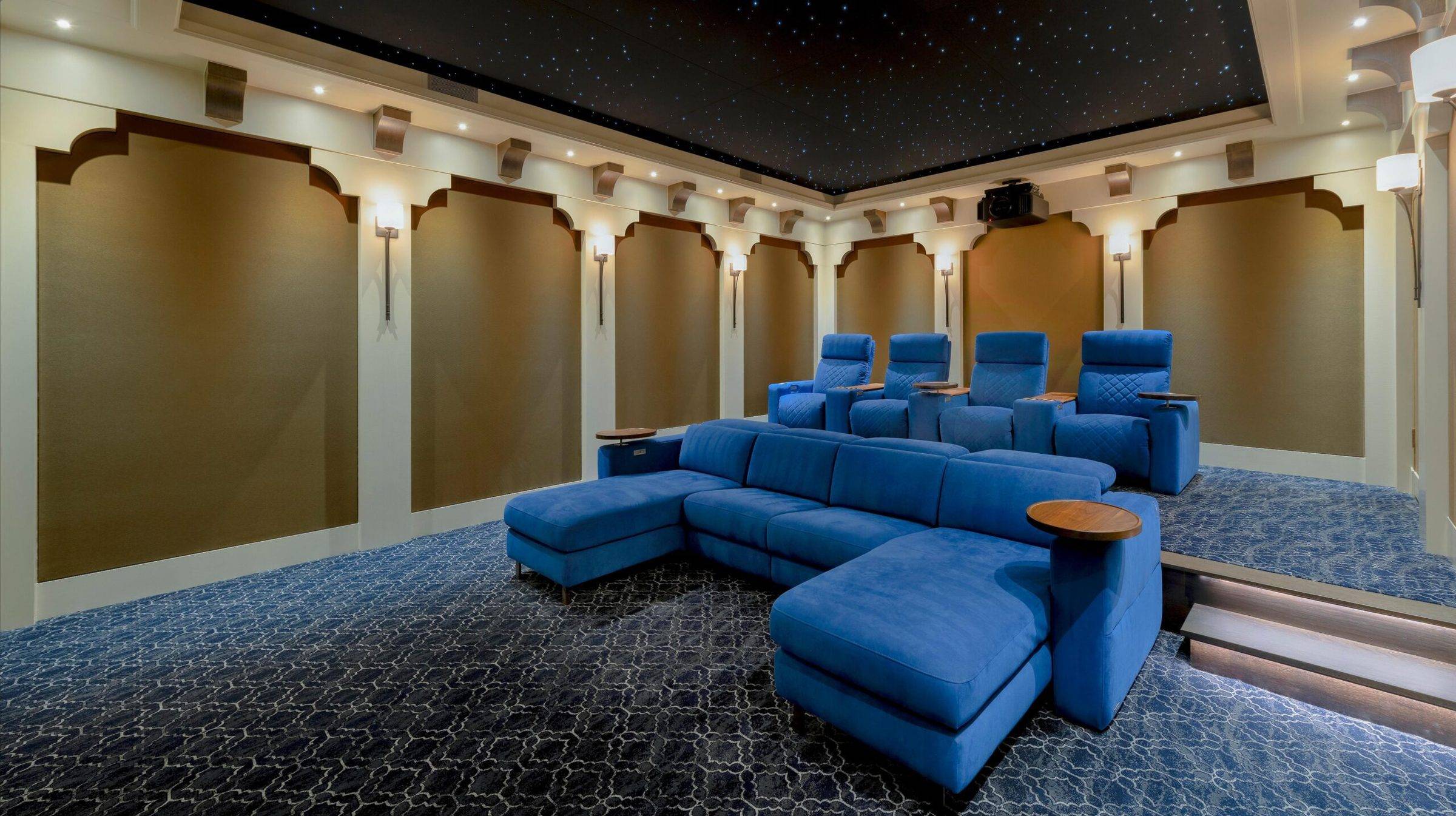
| Starfield inside a cove or tray | A sky framed by lit perimeter coves | High in the panel area | Rooms with soffits or recessed ceilings |
| Dark fabric ceiling, no stars | Quiet and architectural | High | Reference rooms focused only on the picture |
| Painted drywall with fiber stars | Stars on a hard surface | Low | Media rooms where treatment lives elsewhere |
You can see several approaches, from full skies to framed ovals and trays, in our gallery.
Keeping the picture first
A star ceiling is a mood setter. It should never compete with the screen. In a well programmed room the stars glow when guests walk in, stay on softly during previews, and fade out or drop to a faint glow when the film starts. That transition is part of a lighting scene, not something anyone adjusts by hand.
Boston Automations programs these scenes on Lutron lighting with Control4 or Savant control, so one button dims the coves, sconces and stars together and leaves only the step lights on. Our lighting design guide covers the full set of scenes.
Which rooms suit a starfield
Star ceilings are most at home in dedicated private cinemas, where the room is dark enough for the effect to read and the ceiling is already a large acoustic surface. They also work well over a lounge or bar at the back of a theater, where people gather before and after the film and the sky becomes the backdrop for conversation.
In media rooms with windows, the effect is weaker during the day and the ceiling is often busy with recessed lights and HVAC. There, a smaller starfield inside a tray or oval reads better than a full sky, and it gives the room a focal point at night without dominating it in daylight.
Style matters too. A full night sky suits modern and dramatic rooms, like the midnight blue and charcoal theaters in our gallery. Traditional rooms with coffered ceilings and wood paneling often look better with a starfield set into the coffers or framed by crown molding, so the stars feel like part of the architecture rather than a separate effect.
Finally, think about who uses the room. Children love constellations and shooting stars. A film collector may want the ceiling to disappear completely once the movie starts. Both are easy to deliver when the starfield is programmed as part of the lighting scenes instead of running on its own switch.
What to plan during construction
A star ceiling is simple to install when it is planned early and awkward when it is not. Before the ceiling is built:
- Choose a location for the light engine that is outside the theater, ventilated and reachable for service, with power nearby.
- Plan a pathway for the fiber bundle from the engine into the ceiling cavity, avoiding sharp bends.
- Coordinate the ceiling layout with speakers, HVAC grilles, sprinkler heads and the projector so the stars avoid them.
- Decide where the starfield ends and coves or soffits begin.
- Make sure isolation details above the ceiling are complete before panels go up.
CinemaTech's reflected ceiling plan shows all of this on one drawing, which is exactly what the builder and electrician need. If you are planning a new theater, the Design Services Program is where the ceiling takes shape.
More questions
Does a star ceiling hurt the picture?
Not when it is controlled properly. The stars are tiny points of light and should dim or turn off when the film starts. A lighting scene does this automatically, so the starfield sets the mood before the movie and steps aside during it.
Can a star ceiling be added to an existing theater?
Often yes, by replacing or overlaying ceiling panels and finding a place for the light engine. It is easier and cleaner when it is planned before the ceiling is built.
Are fiber optic stars safe to touch?
Yes. The fibers carry only light. The electrical part is the light engine, which sits outside the room in a ventilated, accessible location.