Lighting a home theater the right way
By Adam Zell, Boston Automations | Published | Updated | 6 minute read
The short answer
How should a home theater be lit?
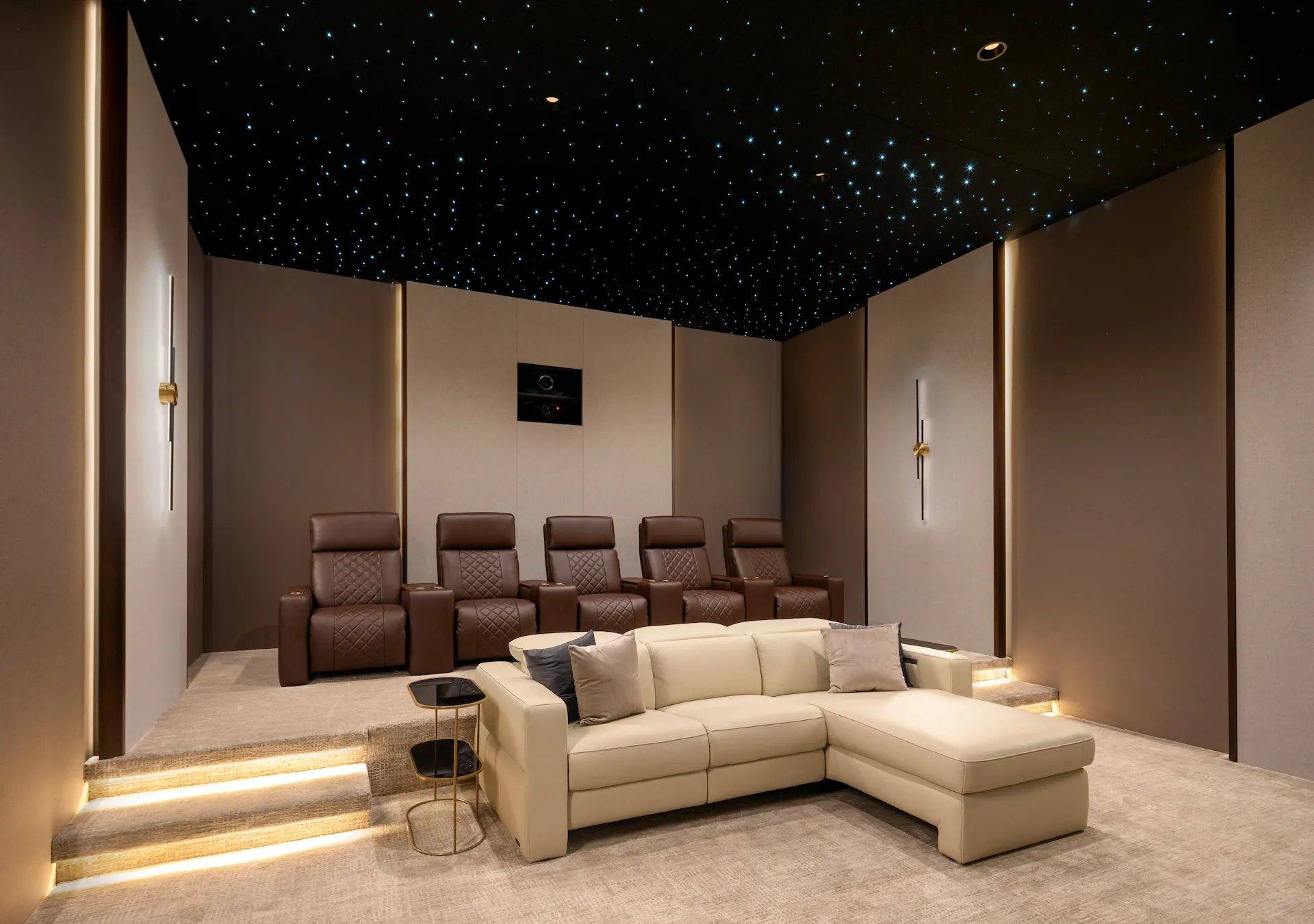
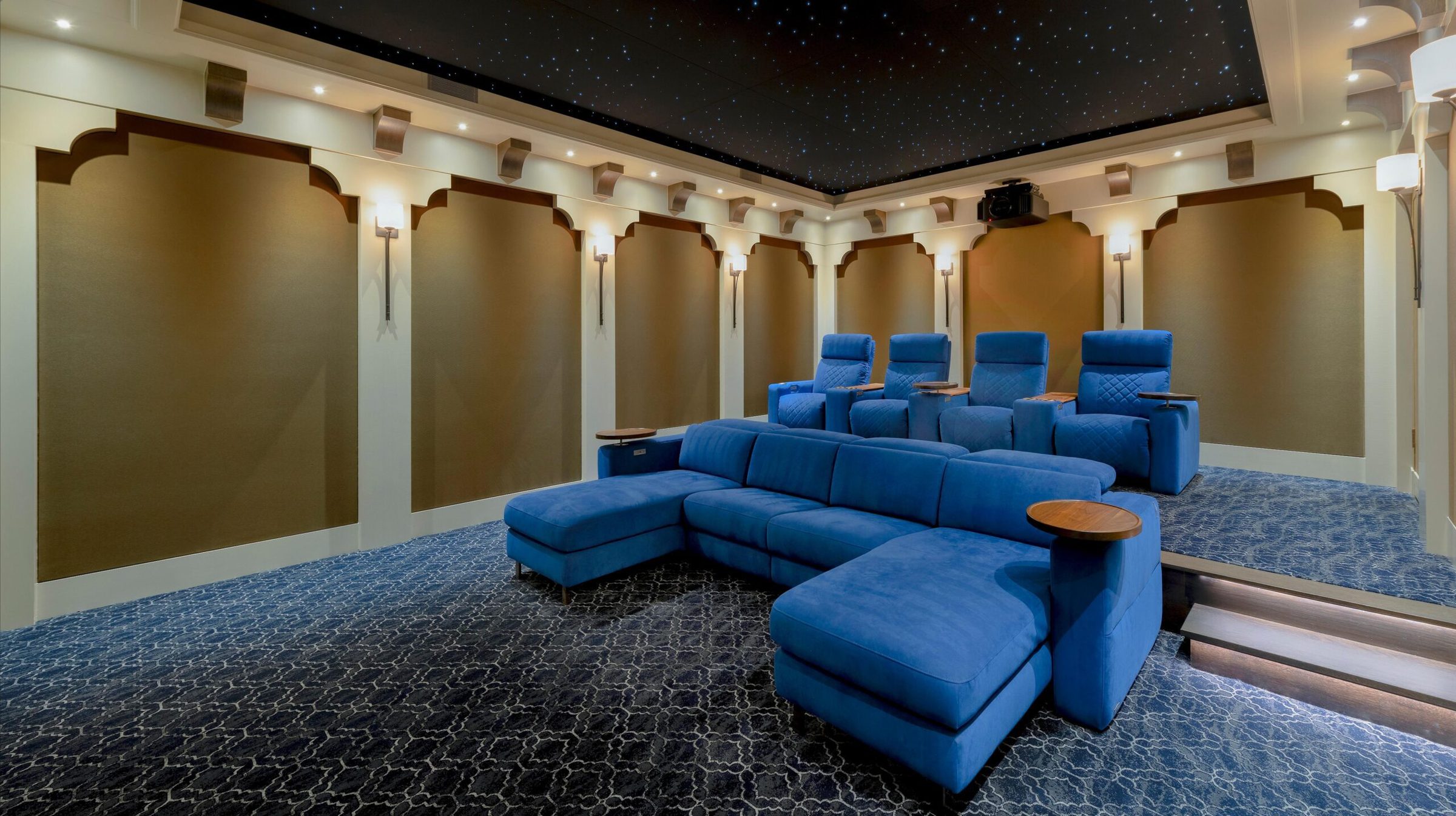
Use layers on dimmers, never a single overhead fixture. Cove or perimeter lighting sets the mood, wall sconces add architecture, step and aisle lights keep people safe, and a star ceiling or feature light gives a focal point. Then program scenes such as Welcome, Movie, Intermission and Clean so one button sets every light, shade and screen together.
Why layers matter
Light in a theater has two jobs that pull in opposite directions. Before and after the film, the room should feel like a beautiful place to gather. During the film, almost all light should disappear so the picture can have deep blacks and full contrast. A single ceiling fixture cannot do both. Layers on dimmers can.
Good theater lighting is also about safety. People walk down steps and across risers in the dark, often carrying drinks. Lighting has to guide them without ever spilling onto the screen.
The four layers
| Layer | What it does | Typical fixtures | During the film |
|---|---|---|---|
| Ambient | Sets the overall mood | LED coves, perimeter soffit lights | Off or very low |
| Architectural | Shows off walls, columns and millwork | Wall sconces, vertical light lines, wall washers | Off |
| Wayfinding | Guides people safely | Step lights, riser lights, aisle lights | On at a low level |
| Feature | Creates a focal point | Fiber optic star ceiling, lit niches, bar lighting | Faint or off |
Every layer goes on its own dimmed zone. That is what makes scenes possible. A room where the coves and sconces share a circuit can never fully separate mood from wayfinding.
Lighting scenes
A scene is a saved combination of light levels, often with shades, the screen and the audio system included. Most private cinemas we program use a handful:
- Welcome. Coves, sconces and stars up, step lights on, music playing softly. This is what guests see when they walk in.
- Movie. Everything fades down over a few seconds except the step lights, which hold at a very low level. The projector and processor are already on.
- Intermission. Coves and steps rise to a comfortable level so people can find the door and the bar, without bright light hitting anyone's eyes.
- Game or party. Brighter, often with color in the coves, for sports and social viewing.
- Clean. Everything on at full, including the recessed lights, for housekeeping.
Fades matter as much as levels. A three to five second fade feels like a real cinema. An instant blackout feels like a power cut.
Protecting the screen
Any light that lands on the screen lowers contrast. When we plan fixtures we check where each beam lands. Sconces should throw light up and down the wall, not out into the room. Step lights should be shielded and aimed at the tread. Coves should be set back far enough that their glow does not reach the screen wall. Dark, matte finishes near the screen also help, which is why CinemaTech's fabric walls are often darker toward the front of the room.
If the room has a star ceiling, it gets the same discipline: on for the mood, down when the film starts.
Fixtures and color
The fixtures themselves are part of the design. In the rooms CinemaTech designs, sconces and light lines are chosen with the fabric panels and millwork, not added after. A few practical points:
- Warm white, roughly 2700K to 3000K, for coves and sconces in most rooms.
- High quality LED drivers that dim smoothly to very low levels without flicker or hum.
- Color changing coves only if you will actually use them, and with a warm white default.
- Step lights on every riser and stair, placed so they never point at a seat.
Common mistakes
Most of the lighting problems we are asked to fix in existing theaters come from a short list. They are easy to avoid on paper and annoying to correct after the walls are finished.
- Too many recessed lights. A grid of downlights makes a theater feel like an office and bounces light onto the screen. Keep them few, dimmed and reserved for cleaning.
- Everything on one circuit. When the coves and the step lights share a dimmer, the room is either too bright for the film or too dark to walk in.
- Glossy surfaces near the screen. Shiny trim, light colored ceilings and polished hardware near the front of the room reflect the picture back at itself and lower contrast.
- Cheap LED drivers. Low cost tape and drivers often flicker, hum or jump to off at the bottom of the dimming range, which is exactly where a theater spends most of its time.
- No plan for the bar or lounge. If the back of the room has a bar, it needs its own zone so it can glow softly for refills without lighting the screen.
A lighting plan drawn with the seating and acoustic layout avoids all of these. It is one of the reasons the Design Services Program treats lighting as part of the room, not a separate trade.
Control and planning
Boston Automations installs Lutron lighting controlled by Control4 or Savant, so the theater scenes live on a keypad by the door, on the theater remote and on your phone. Scenes can also reach beyond the room. Pressing Movie can dim the hallway outside, close the shades in an adjoining bar and set the projector to the right input.
To make that work, plan these items before drywall:
- Separate dimmed zones for coves, sconces, steps, recessed lights and features.
- Blocking and power for every sconce location shown on the wall elevations.
- Low voltage pathways for keypads and any LED power supplies.
- A location for lighting panels or processors, ideally with the AV equipment.
CinemaTech's elevations and reflected ceiling plans show every fixture location, which makes the electrician's job straightforward. Learn more about the systems we integrate on the technology page, or see how lighting plays out in our private cinemas.
More questions
Should a home theater have recessed lights?
A few, on dimmers, for cleaning and finding a lost remote. They should not be the main light source. Recessed lights shine down onto seats and reflect up onto the screen, which is why theaters rely on coves, sconces and step lights instead.
What color should theater lighting be?
Warm white, roughly 2700K to 3000K, for most of the room. Color changing light can be fun for coves and parties, but the default scenes should be warm and calm.
Can theater lighting tie into the rest of the house?
Yes. With Lutron lighting and Control4 or Savant control, the theater scenes can also dim the hallway, close shades and turn on the bar lights, all from one button.