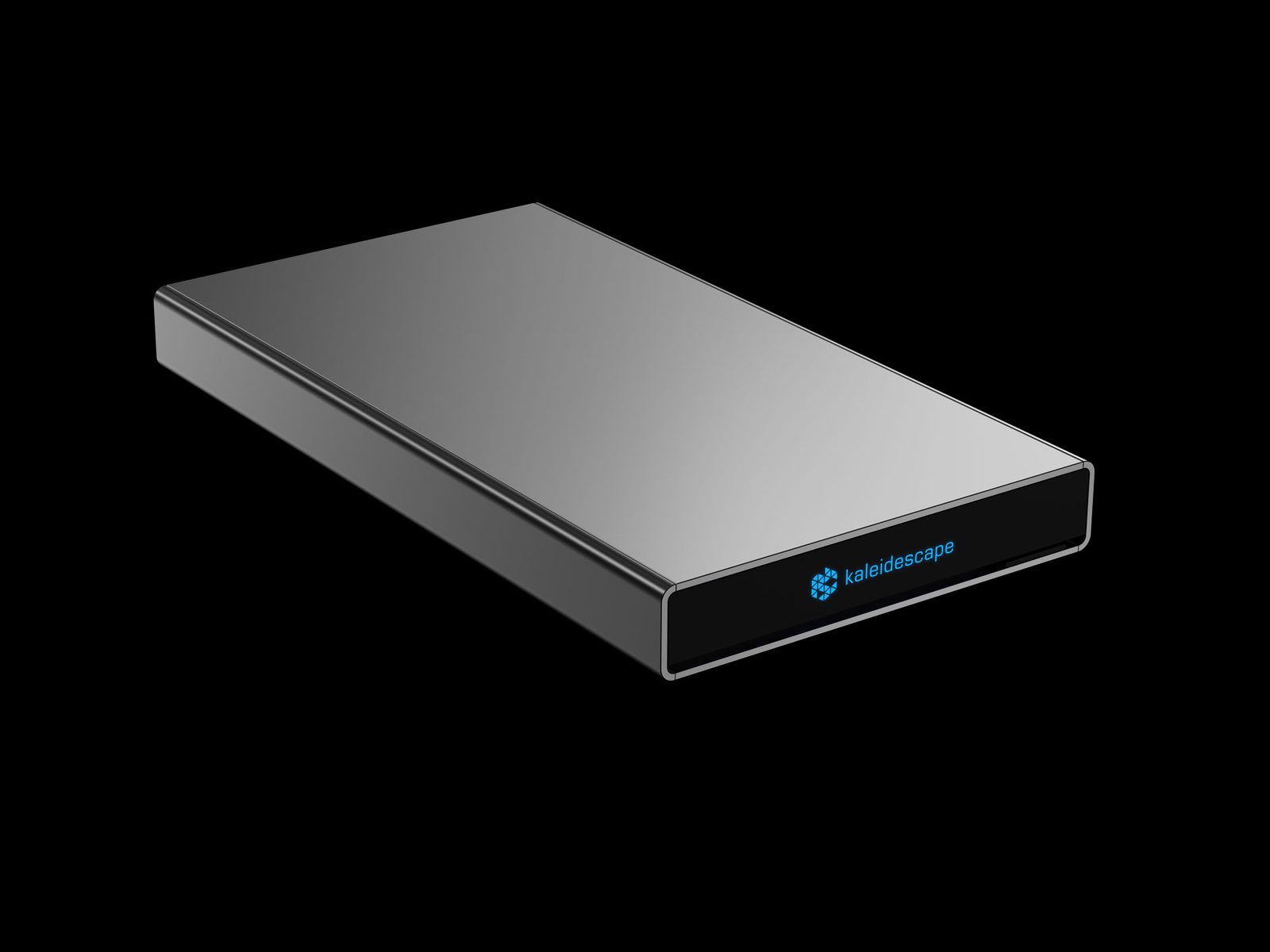
Choosing a Kaleidescape system: players, servers and storage
By Adam Zell, Boston Automations | Published | Updated | 8 minute read
The short answer
Which Kaleidescape system should I choose?
For a reference cinema, the Strato K with its 4K Cinematic format. For a single room that wants Dolby Vision and storage in one box, the Strato V. For media rooms and second rooms, the Strato E. When several rooms share a library or the collection outgrows a player's drive, add a Terra Prime server and let each room's player draw from it.
Start with the rooms
A Kaleidescape system is built from two kinds of hardware: players, one for each screen, and servers, which hold larger libraries. Choosing well starts with three questions. Which rooms will play films? How good is the display and sound in each? How many films do you want available at any time?
A single theater can run on one player with internal storage. A house with a cinema, a family room and a primary suite usually wants a server and a player in each room. The answers decide the rest.
The Strato players compared
| Player | Picture | Internal storage | Best room |
|---|---|---|---|
| Strato K | Native 8K, 4K Cinematic, Dolby Vision to 4K, HDR10 to 8K | Solid state drive | Reference cinema |
| Strato V | 4K, Dolby Vision, HDR10 | 960 GB, about ten 4K films | Theater or media room |
| Strato E | 4K, Dolby Vision, HDR10 | 480 GB, about six 4K films | Media room, second rooms |
| Strato C | 4K, HDR10 | None, needs a Terra server | Rooms in an existing system |
All of them deliver lossless Dolby Atmos and DTS:X soundtracks.
Strato K
The Strato K, launched in June 2026, is the flagship. Its headline feature is 4K Cinematic, a Kaleidescape format that keeps full chroma resolution up to 4:4:4 and uses much higher bitrates than standard 4K. It also plays native 8K titles, though the 8K catalog is still very small. Dolby Vision works up to 4K, and HDR10 up to 8K.
The Strato K connects over HDMI 2.1 with HDCP 2.3, so the projector, processor and any switching in between need to support the same standards for its highest formats to pass. Choose it for the main cinema when the projector, screen and processing can resolve the extra detail. Paired with a madVR Envy and a high end 4K projector, it is the most capable source Kaleidescape has made.
Strato V
The Strato V is a complete 4K Dolby Vision player with a 960 GB internal drive, enough for roughly ten reference quality films. It works on its own, or groups with a Terra Prime server. For many single theaters and media rooms it is the natural choice. It supports Dolby Vision in standard and low latency modes, so it suits both projectors that accept Dolby Vision and televisions that handle it internally.
Strato E
The Strato E is the entry player. It plays the same 4K titles with Dolby Vision and lossless audio, holds about six films on its 480 GB drive, and connects by HDMI, with a THX Certified HDMI cable in the box. Reviewers found its playback quality matches the Strato V. In a whole house system it is an efficient way to bring the library to a family room, bedroom or guest suite.
Strato C
The Strato C is an earlier player with no internal storage, so it always plays from a Terra server. It supports HDR10 but not Dolby Vision or HDR10+. It still appears in Kaleidescape's comparison chart, but for new systems we usually prefer the Strato E or Strato V, which add Dolby Vision. We confirm current availability before specifying it.
Terra Prime servers
A Terra Prime server is where a large library lives. Players group with it on the home network and play from it, several at a time. Kaleidescape offers Terra Prime servers in a range of capacities, and as of CEDIA Expo 2026 the largest is the 246TB Compact Terra Prime. We confirm the current range when we specify a system.
The 246TB model uses two 123TB solid state drives and holds, by Kaleidescape's estimate, about 4,000 4K films. It supports up to 25 simultaneous playbacks, runs at 20 dB(A) and is sold by special order. It is the right answer for very large collections and many rooms, not for every home.
Sizing storage
Storage is easier to size if you think in films rather than terabytes.
- A rotating handful. If you download what you plan to watch and remove films afterward, a player's internal drive is enough.
- A family collection. If you keep everything you buy and add films regularly, plan for a server from the start.
- 4K Cinematic and 8K. These files are larger. A Strato K library needs more space per film than a 4K library.
- Growth. Plan for the library you expect in five years, not the one you have today.
Matching the player to the room
A player can only show what the rest of the chain passes through. Before choosing one, we check three things in each room.
- The display. Does it accept Dolby Vision, or HDR10 only? Many televisions support Dolby Vision, while most home projectors do not, which is one reason a projector cinema often pairs the player with a madVR Envy.
- The sound system. Lossless Atmos and DTS:X need a surround processor that decodes them. A soundbar room will not reveal what the soundtrack carries.
- The HDMI path. Every switch, extender and cable between the player and the display has to carry the format. It is far easier to get right on paper than after the walls close.
Starting small and adding later
Choosing a single player now does not lock you in. Kaleidescape keeps your purchase list in its cloud, and films you remove can be downloaded again later, so a library can move from a player's drive onto a server without buying anything twice. In new construction we still run network cable and plan rack space for the full system from the start, because walls are easier to open before the plaster goes up.
Typical combinations
| Home | Typical system |
|---|---|
| One media room | Strato E or Strato V on its own |
| Dedicated cinema | Strato K or Strato V, with a madVR Envy for a projector |
| Cinema plus two or three rooms | Terra Prime server, Strato K in the cinema, Strato E or V elsewhere |
| Large estate or collection | Compact Terra Prime 246TB with players in every viewing room |
We size the system with you during design, along with the rack, network and control. See Kaleidescape in multiple rooms for how whole house systems come together.
More questions
Can I start with one player and add a server later?
Yes. A Strato player with internal storage works on its own, and later it can group with a Terra Prime server on the network. Films already on the player stay available. It is a sensible way to start.
Does a Kaleidescape player need a fast internet connection?
Only for downloading. Films play from storage in your home, so the connection never affects picture or sound once a film has arrived. A faster connection shortens downloads, which matters most with large 4K and 4K Cinematic files. We plan the network and internet service together during design.
Should every room get the flagship player?
Rarely. The Strato K makes sense in the main cinema with a projector and processor that can show 4K Cinematic. Media rooms and bedrooms are usually well served by a Strato V or Strato E drawing from the same library.
