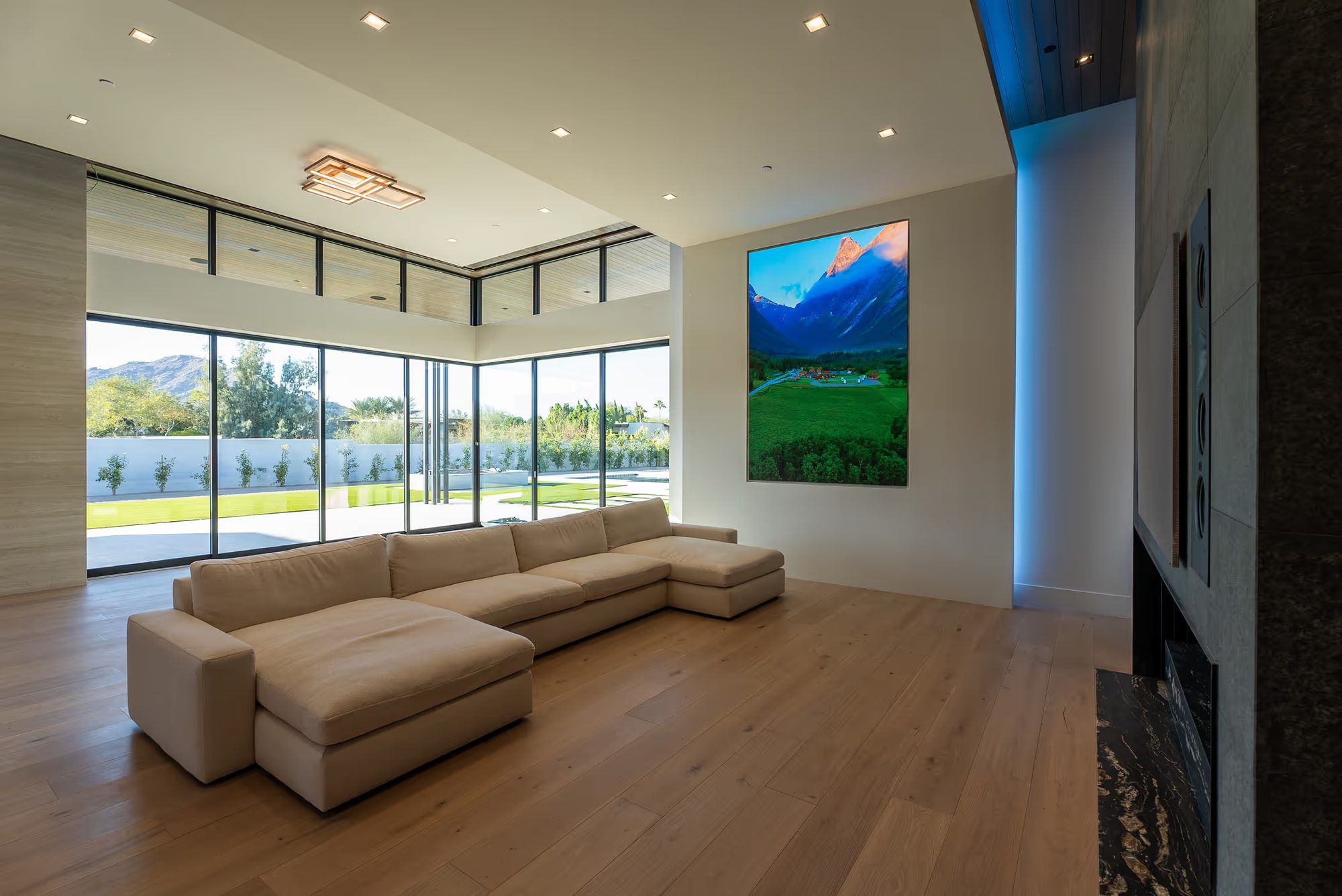
What a MicroLED video wall is, and whether your home needs one
By Adam Zell, Boston Automations | Published | Updated | 7 minute read
The short answer
What is a MicroLED video wall?
A MicroLED video wall is a large screen made of modular panels covered in tiny LEDs that each produce their own light. Because there is no backlight or projector, the picture stays bright and saturated in daylight, and the wall can be built to almost any size. In a home it replaces a television or projector in a media room, great room or theater.
What a video wall is
A video wall is one large screen assembled from many smaller LED panels. Each panel is covered in tiny red, green and blue LEDs, and each group of three is a pixel that makes its own light. A processor takes your video signal, from a film server, a cable box or a games console, and spreads it across every panel so the whole wall shows a single picture.
Because the light comes from the pixels themselves, there is no projector beam to wash out and no backlight to glow through dark scenes. The picture holds its color and contrast in a room full of daylight, and the screen can be as wide as the wall. That combination, size and brightness together, is what no television or projector quite matches.
MicroLED, DVLED and the words people use
You will hear several names for the same family of screens. In plain terms:
- Direct view LED, or DVLED. Any screen made of LEDs you look at directly. It covers everything from stadium scoreboards to the finest residential walls.
- Fine pitch LED. DVLED with pixels close enough together to view from inside a room, rather than from across a street.
- MicroLED. The finest end of fine pitch, with very small LED chips packed tightly. Manufacturers draw the line in different places, so the label alone tells you little.
- Pixel pitch. The distance between neighboring pixels in millimeters. This is the number that matters most. Our pixel pitch guide explains how to choose it.
When we compare walls, we look past the name to the pitch, the quality and matching of the panels, the surface finish, the processor and how the wall is serviced.
How it compares with a TV and a projector
| MicroLED wall | Large TV | Projector and screen | |
|---|---|---|---|
| Size | About 100 inches to a full wall | Up to about 115 inches | About 120 to 200 inches |
| Daylight | Excellent | Very good | Needs a dark room or special screen |
| Speakers behind the picture | No | No | Yes, with a transparent screen |
| Installation | Structure, circuits, cooling, service access | Wall blocking and power | Projector position and screen wall |
| When it is off | Can show art or blend in | A dark rectangle | Screen can retract |
We go deeper on each pairing in LED wall vs projector and video wall vs a very large TV.
Which rooms suit a video wall
Great rooms and family rooms. These are where a video wall makes the most sense. They have windows, people use them all day, and nobody wants to draw blackout shades for an afternoon game. A wall gives a theater sized picture without turning the room into a theater.
Media rooms and lower level lounges. A wall lets one room work for films at night and sport, gaming and music during the day. See our media rooms page for how we design these spaces.
Dedicated cinemas. A wall brings extraordinary brightness and HDR to a private theater. Projection still gives a larger picture for the money and lets speakers hide behind the screen, so the choice here is a real one rather than automatic.
Entry halls, stairs and dining rooms. A smaller canvas, set into the wall, shows digital art most of the time. See video walls as digital art.
Terraces and pool houses. Outdoor walls bring the same idea outside, with the weather planning New England demands. See outdoor LED walls in New England.
The decisions that shape the wall
- Seating distance and pitch. How close the nearest seat is decides the pixel pitch, and the pitch decides how big a 4K wall will be.
- Size and shape. 16:9 for television, wider shapes for scope films, square or custom proportions for art.
- Structure and service. The wall needs a flat, strong surface and a way to replace panels from the front or behind.
- Power and heat. Large walls need dedicated circuits, and the heat they produce has to leave the room.
- Sound. Speakers go around the wall, not behind it, so their positions are designed with the wall dimensions.
- Processing. How many sources the wall shows at once, and whether it must handle high frame rate games, decides which processor drives it and where that processor lives.
- Calibration. Every panel is matched for color and brightness, with separate settings for daylight and evening.
- The resting state. What the wall shows, or hides, when it is off.
Each of these touches the architecture. Our installation guide covers what the house has to provide.
The walls we design with
We work with two manufacturers. Just Video Walls was founded in Florida in 2022 by integrator Ryan Lampel and makes only MicroLED walls, indoor and outdoor. Its Spec Series offers preconfigured systems, and its Autograph line builds fully custom walls for luxury homes. At CEDIA Expo 2025 it showed a 0.7mm indoor wall for very close viewing.
Eleusis Digital Canvas, founded in Utah in 2020, builds fine pitch direct view LED canvases, with pitches as fine as 0.9mm, designed to recess almost flush into the wall and to show art. Its Gallery Series is built around digital art from Blackdove. Between the two, we can suit almost any room.
Where to start
Start with the room, not the product. A floor plan, the seating you have in mind and a few photos of the wall tell us most of what we need to suggest a pitch, a size and a manufacturer. If the house is being designed or renovated, bring us in while the drawings are still moving, since that is when structure, power and cooling are cheapest to get right.
See the video walls page for an overview, or tell us about your room.
More questions
Does a video wall have visible seams between panels?
A well built, well calibrated wall should not show seams from the seats. Panels are aligned on a precise mounting structure and color matched during calibration. Seams usually appear only when the wall behind is out of flat or panels from different batches are mixed.
Can a video wall be added to a finished room?
Often, yes, though it is easier in a renovation or new build. In a finished room we check the wall structure, the electrical capacity and how heat will leave the room before recommending a size.
Is a MicroLED wall the same as a Samsung MicroLED television?
They share the same basic technology, self lit LEDs at a fine pitch. The walls we design are built from modular panels to a size and shape chosen for the room, rather than sold as a fixed size television.
