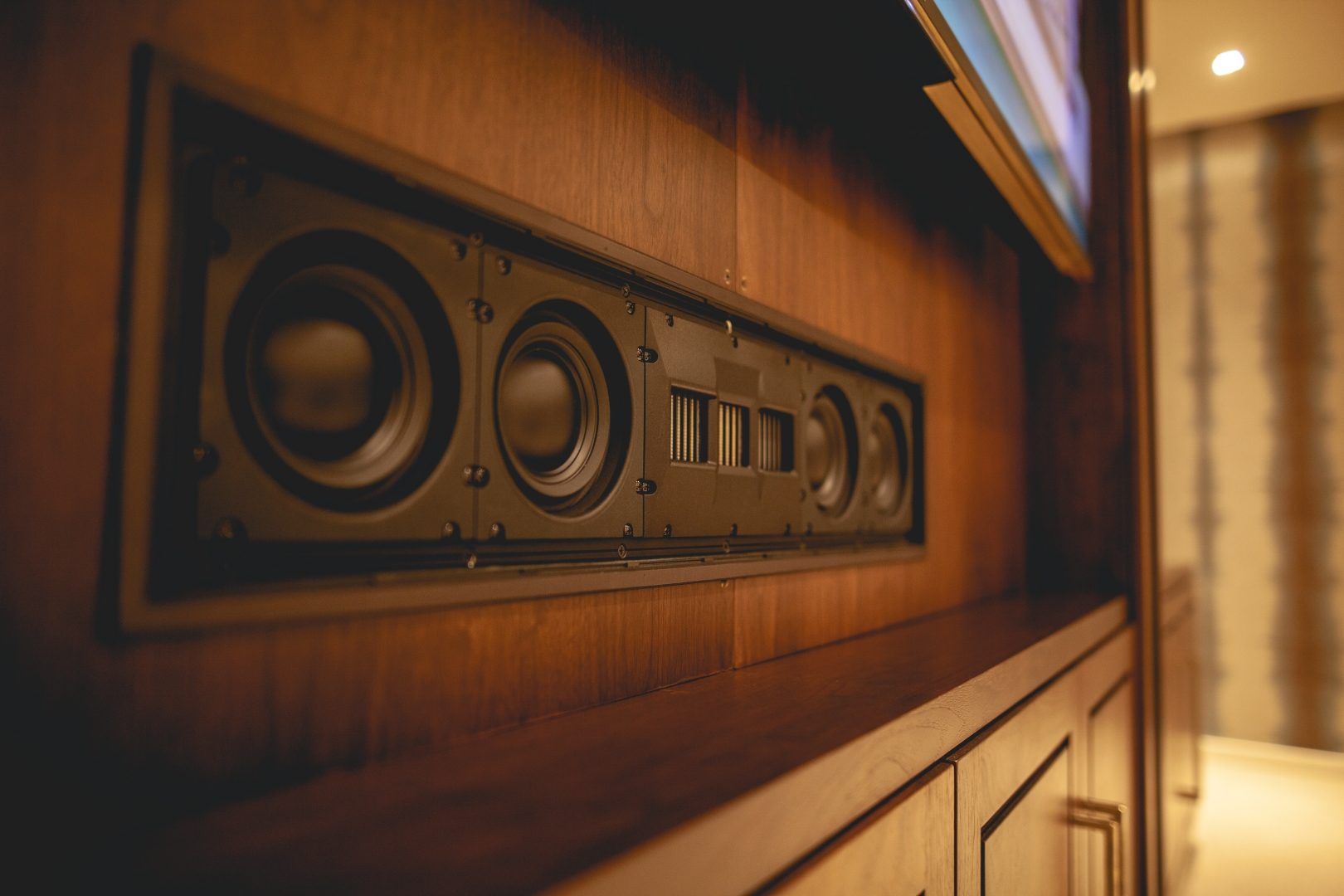
In-wall or freestanding speakers for a home theater?
By Adam Zell, Boston Automations | Published | Updated | 7 minute read
The short answer
Are in-wall speakers as good as freestanding speakers in a home theater?
The best in-wall speakers, installed in a properly built wall or baffle wall, match or beat freestanding speakers in a dedicated theater, and they free up floor space and hide behind the screen. Freestanding speakers are easier to move and adjust. What matters most is the speaker's design, a rigid mounting, and positions planned from the seating layout.
Three ways to mount a speaker
Every theater speaker is one of three types. Freestanding speakers sit on the floor or on stands. On-wall speakers hang on the wall surface, sometimes behind a screen or fabric. In-wall speakers mount inside the wall cavity, so only a grille, or nothing at all, shows in the room.
There is an old idea that in-wall speakers are a compromise. That was true when they were thin panels dropped into a hollow wall. The best modern in-wall speakers are full systems with their own sealed enclosures, and in a properly built wall they perform as well as freestanding speakers, sometimes better.
Mounting options compared
| Type | Strengths | Watch for | Best room |
|---|---|---|---|
| In-wall | Hidden, no floor space, rigid mounting, no reflections from the wall behind | Needs planning before drywall, wall depth and framing | Dedicated theaters and media rooms |
| On-wall | Larger cabinets than a wall cavity allows, still hidden behind fabric or screen | Takes depth from the room, needs strong mounting | Large theaters with fabric walls |
| Freestanding | Easy to place, adjust and change later | Visible, uses floor space, reflections from the wall behind | Music rooms and rooms with no screen wall |
Why the wall matters
An in-wall speaker is only as good as what it is mounted in. A hollow wall cavity can resonate, rattle and let bass leak into neighboring rooms. Two things fix that.
- A sealed enclosure. Speakers with their own back box, such as the aluminum enclosure of the James QX830, behave the same in any wall because the speaker no longer depends on the cavity behind it.
- Rigid framing. Blocking, solid mounting and the right wall depth keep the speaker from moving the wall. Some speakers need more depth: Wisdom calls for 2x6 framing or deeper for its Sage Cinema Hybrid Line Source.
There is also an acoustic benefit. A freestanding speaker sends some sound backward, which reflects off the wall behind it and colors the bass. A speaker set flush in a wall has no wall behind it to reflect from, so its bass is often smoother.
Baffle walls behind the screen
In a dedicated cinema, the front speakers usually hide behind an acoustically transparent screen. The best way to mount them is a baffle wall: a solid, flat wall built just behind the screen, with the left, center and right speakers and often the subwoofers set into it, and everything else finished in black absorptive material.
A baffle wall gives the speakers a large, rigid surface to work against, removes reflections from behind the screen and makes the front of the room look like nothing but a picture. It is where tall in-wall speakers, such as Wisdom's Sage L75i, make the most sense. CinemaTech's drawings include the screen wall detail, and our planar speaker guide explains why tall line sources suit it.
Grilles and fabric walls
In a dedicated theater, in-wall speakers usually disappear behind stretched acoustic fabric, so the grilles never show and the walls read as one continuous finish. The fabric has to be acoustically open, and the panel layout is drawn so seams and trim fall clear of each speaker. In rooms with painted walls, the grille is what you see. Low profile grilles that sit only slightly proud of the surface, painted to match, are the usual answer, and their positions are set on the elevations alongside sconces and outlets.
Surrounds and overheads
Side and rear surrounds are almost always in-wall or on-wall in a dedicated theater. Freestanding surrounds would block aisles and sit at the wrong height for seats on risers. We usually mount them a little above ear height, behind acoustic fabric, so the back rows are not shadowed by heads in front.
Overhead speakers for Dolby Atmos go in the ceiling. In a theater with a star ceiling or acoustic panels, the speaker locations are planned with the panel layout so the speakers sit behind fabric between fibers. Matching the surrounds and overheads in tone to the front speakers helps sounds move smoothly around the room.
When freestanding makes sense
Freestanding speakers still have a place. If you are building a room primarily for music, with no screen in the way, a pair of great freestanding speakers placed for stereo is hard to beat. They are also easier to adjust: moving a speaker a few inches is simple on the floor and much harder in a wall. And if a room may be reconfigured in a few years, freestanding speakers can move with it.
In dedicated theaters, though, freestanding speakers behind a screen take up depth without giving much back. We usually prefer in-wall or on-wall designs there.
In-wall speakers in media rooms
Media rooms and family rooms are where in-wall speakers earn their keep. A large television or a projection screen on the wall, with in-wall left, center and right speakers around it, keeps dialogue near the picture without towers on either side. Grilles can be painted to match the wall. Surrounds go in the side and rear walls, and overhead speakers go in the ceiling.
For rooms where even a grille is too much, there are small aperture and fully invisible options. Our guide to hidden speakers for living rooms covers them.
What to decide early
In-wall speakers reward early decisions. Before framing, we settle:
- Speaker models and the wall depth each one needs
- Exact positions, set from the screen size and seating plan
- Blocking and backing for every speaker and subwoofer
- Wire runs, including extra runs for bi-amplified or tri-amplified speakers
- How each speaker relates to sconces, fabric seams and light lines on the finished wall
Get those right and an in-wall system disappears. See the full range we design with on the home theater audio page.
The same thinking applies to renovations. If walls are being opened anyway, it is the right moment to add blocking, wire and back boxes for in-wall speakers, even if some will be installed later. A wall framed and wired for the future costs little during construction and saves opening finished plaster years from now.
More questions
Do in-wall speakers leak more sound into other rooms?
They can, if they are mounted in an open stud cavity. Speakers with sealed back boxes, such as aluminum enclosure models, keep most of their energy in the box. Real sound isolation still comes from the wall construction itself, which we coordinate with your builder.
Can freestanding speakers go behind an acoustically transparent screen?
Yes. Many theaters place freestanding or on-wall speakers behind the screen on stands or brackets, then cover the wall in black. A baffle wall usually performs better and uses the space more efficiently, but both work.
Are in-ceiling speakers good enough for a theater?
For Dolby Atmos overhead channels they are the standard approach. For the main front speakers in a dedicated theater we prefer in-wall or behind-screen speakers at ear height, since dialogue should come from the screen, not the ceiling.
