Planning a home theater for a lake house
By Adam Zell, Boston Automations | Published | Updated | 7 minute read
The short answer
What is different about a home theater in a lake house?
A lake house theater has to survive the months nobody is there. That means controlling humidity all year, protecting equipment from outages and lightning, choosing gear that tolerates cold starts, and building in remote monitoring so problems are found from Boston, not discovered in June. The room itself is often a media room that opens to the view by day and darkens at night.
Why a lake house is different
A home theater in Weston is used every week. A theater on Lake Winnipesaukee, Squam, Sunapee or Sebago might be used hard for ten weeks in summer, on a few long weekends in the fall and over the holidays, and then sit closed for stretches at a time. That pattern changes how the room should be designed.
The picture and sound standards are the same as in a primary home. What changes is everything around them: humidity control when no one is there, protection from outages and storms, equipment that recovers on its own, and a way for us to see the system from afar. A theater that works perfectly on the Fourth of July but greets you with a dead projector at Thanksgiving is not a luxury.
Theater or media room?
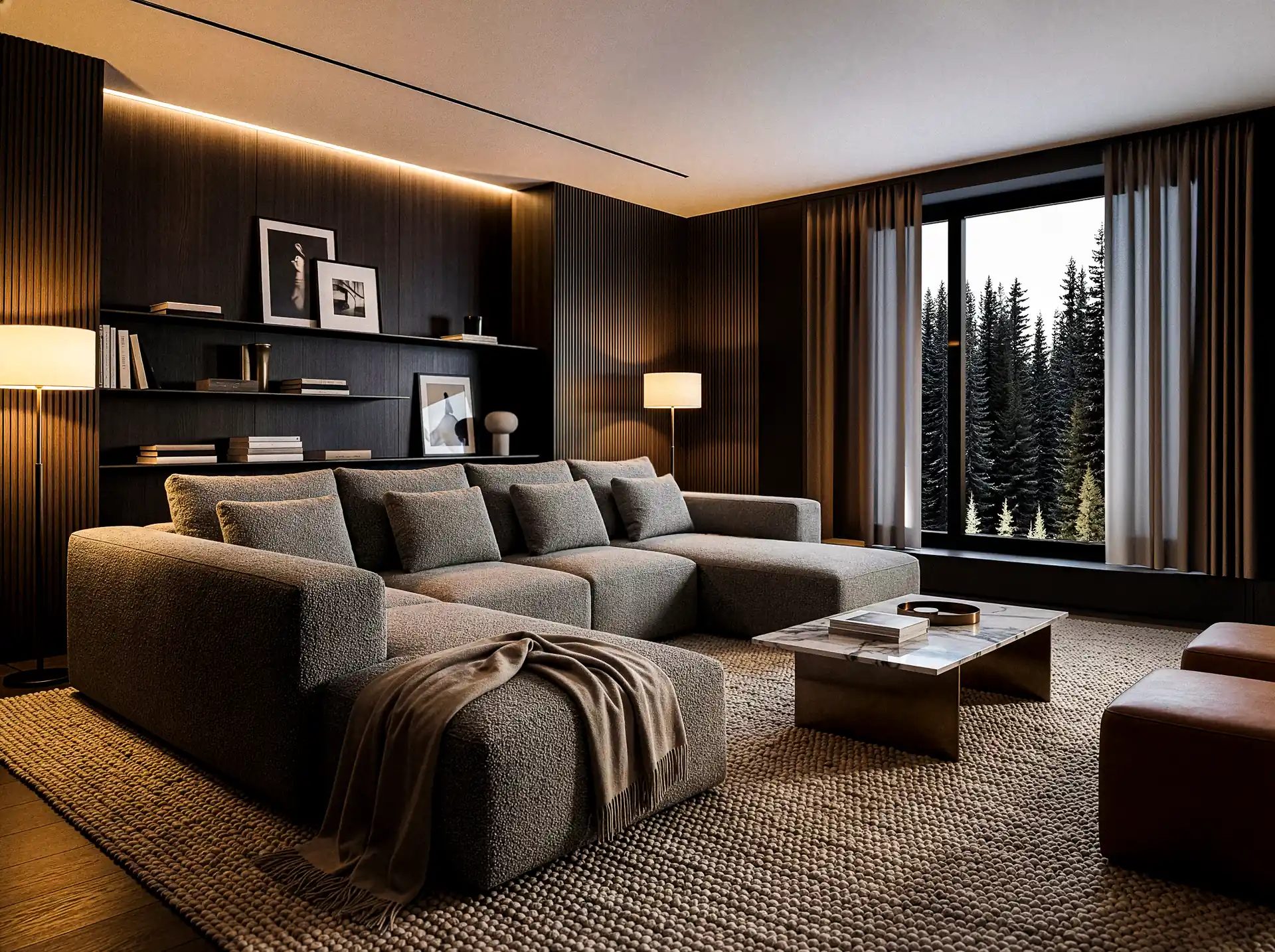
Most lake houses are built around the view, so the main living space is full of glass. That room makes a beautiful media room for daytime games and family movies, but it will never be dark at 3 in the afternoon. A dedicated cinema usually lands on the lower level, often a walkout, where one or two walls are below grade and the windows can be limited or shaded.
Many families do both: a large display and a good sound system in the great room for everyday use, and a smaller, fully dark private cinema downstairs for films and rainy days. Our guide on home theaters and media rooms covers the tradeoffs.
| Room | Best display | Light control | Typical use |
|---|---|---|---|
| Great room facing the lake | Large TV or LED display | Motorized shades for evenings | Games, news, family movies |
| Walkout lower level | Projector or large display | Blackout shades on the walkout glass | Films, kids, rainy days |
| Interior lower level room | Projector and acoustically transparent screen | No windows needed | Private cinema |
Humidity and the empty months
Lake air is damp in summer, and lower levels near the water stay cool, which is how condensation and musty smells start. A theater is full of things that absorb moisture: upholstered seating, fabric wrapped acoustic panels and carpet. Electronics do not like it either.
The answer is a room on conditioned air with dehumidification that runs all year, including when the house is closed. The EPA recommends keeping indoor relative humidity below 60 percent and ideally between 30 and 50 percent. Give the mechanical designer that target for the theater and the equipment room, and add a humidity sensor that reports to the control system so a drift is visible long before it becomes damage.
In winter, the heat stays on. Equipment is happy in a heated house, but if the heat fails, a projector or amplifier should not be switched on until the room has warmed and any condensation is gone. That is one more reason to monitor temperature remotely.
Power, outages and lightning
Lake roads are lined with trees, and winter storms and summer thunderstorms can bring lines down. Each outage is also a chance for a surge when power returns. For a theater, we plan three layers:
- Surge protection and power conditioning on every rack and display, and on the incoming cable, network and antenna lines, which are common surge paths.
- Battery backup (UPS) for the network, the control processor and anything that should shut down gracefully rather than lose power mid operation.
- A standby generator for the house. Our sister company Boston Backup Power plans generators and battery systems, and we coordinate the theater's circuits with that design.
Equipment is also set to restart in a known state after power returns, so the system comes back on its own and does not need someone on site to reset it.
Remote monitoring
The single most useful feature in a seasonal home is the ability to see and fix problems from a distance. Modern control platforms and network equipment can report device status, cycle power to a frozen component, update firmware and alert the integrator when something drops offline. With the homeowner's permission, many problems can be fixed before anyone drives north.
We recommend pairing that with environmental sensors: temperature, humidity and water leak detection near the equipment room and any plumbing in the lower level. The same alerts that protect the theater protect the house. Our guide to Control4, Savant and Lutron explains how these systems fit together.
Internet at the lake
Streaming in 4K and remote support both depend on a reliable connection, and some lake roads still have limited service. We confirm what is available at the address early. Where the main service is slow or unreliable, a second connection on a different technology can serve as a failover so remote access survives an outage. For films, a movie server that stores titles locally, like those on our Kaleidescape and madVR page, plays at full quality no matter what the internet is doing.
A lake house checklist
- Decide which room is for daytime viewing and which, if any, is fully dark.
- Put the theater and equipment room on year round conditioning and dehumidification.
- Add temperature, humidity and leak sensors that report remotely.
- Protect every power and signal line from surges, and back up the network and control system.
- Plan generator coverage for the circuits you want to keep alive.
- Confirm internet service and add a failover connection where needed.
- Store films locally so movie night does not depend on bandwidth.
- Keep controls simple, because guests and renters will use them too.
If you are planning a lake house or renovating one, tell us about the property. We can review drawings with your architect long before the season starts.
More questions
Can I leave the theater equipment at the lake house over winter?
Yes, if the house stays heated and dehumidified and the equipment sits on surge protection with remote monitoring. Equipment problems in seasonal homes usually come from moisture, power events and long periods without anyone noticing a fault, not from the cold itself.
Should a lake house theater use a projector or a TV?
If the room has big windows to the water, a large TV or LED display is usually the better daytime choice, with blackout shades for evening films. A projector makes sense in a lower level room that can be fully darkened.
Do you work on lake houses in New Hampshire and Maine?
Yes. We plan theaters and media rooms across New Hampshire and Maine as well as Massachusetts and Rhode Island, and we recommend designing a lake house system so it can be supported remotely between visits.
