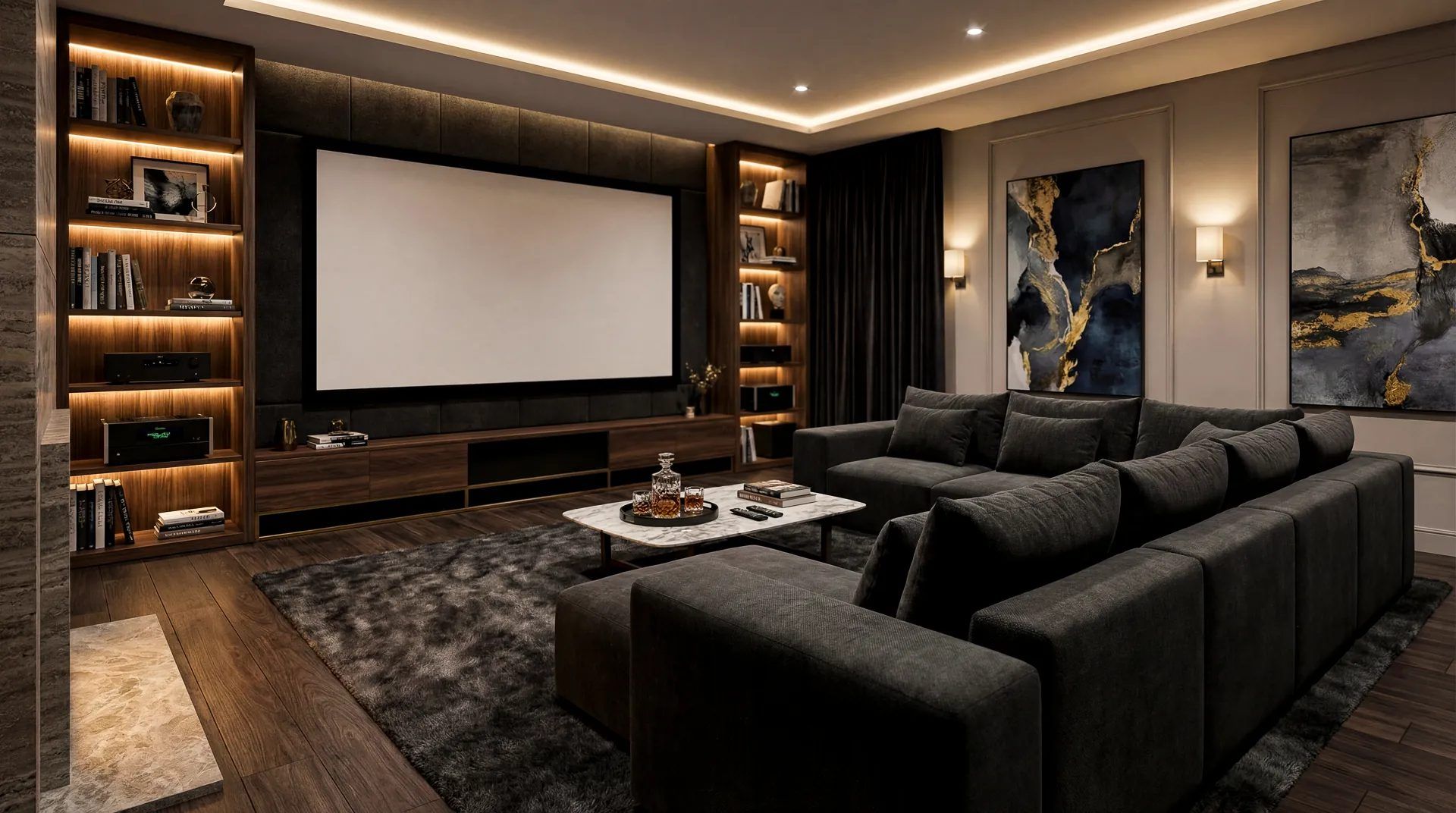
A 100 inch TV or a projector in a media room?
By Adam Zell, Boston Automations | Published | Updated | 7 minute read
The short answer
Is a 100 inch TV better than a projector for a media room?
In a media room with windows that is used every day, usually yes. A 98 to 115 inch television keeps its contrast in daylight, turns on instantly and needs no dark room. A projector wins when the room can be darkened and you want an image of 120 inches or more with speakers hidden behind it. Many families use both.
The question at 98 inches and up
Our projector vs TV guide covers the general choice for a theater. This guide is narrower. Now that Sony and Samsung sell televisions of 98 to 115 inches with red, green and blue LED backlights, the gap between a large television and projection in a media room is smaller than it has ever been. The question is no longer whether a TV can be big enough. It is whether your room needs the extra size only projection can give.
A 115 inch TV against a 135 inch projector
Here is how a flagship 115 inch television compares with a typical media room projector setup at 135 inches, a size many rooms can fit.
| 115 inch TV | 135 inch projector and screen | |
|---|---|---|
| Image size | About 100 by 56 in | About 118 by 66 in |
| Daylight | Holds contrast with shades open | Needs shades or an ALR screen |
| Speakers behind the image | No | Yes, with an acoustically transparent screen |
| When it is off | A large dark panel | A screen that can retract or hide |
| Ceiling and rear wall | Not involved | Projector mount or soffit, throw distance |
| Delivery | A 9 foot carton | A screen frame assembled on site |
A 135 inch screen has roughly 38 percent more area than a 115 inch television. That is noticeable, but less dramatic than the jump from an 85 inch set to projection was a few years ago.
How daylight affects the choice
A projector cannot make black. The darkest part of its image is the light already falling on the screen. In a dedicated theater with dark finishes that is almost nothing. In a media room with windows, a white ceiling and pale walls, it is a lot, and the picture turns gray during the day.
A large LCD television keeps its contrast because it makes its own light behind a dark panel. The newest finishes help further: Samsung says its 115 inch Micro RGB is UL verified as Glare Free. So if the room is used every afternoon for games, sports and children's films with the shades open, the television is usually the better daily screen.
Ambient light rejecting screens narrow the gap. They reflect projector light toward the seats and reject light from above. They work well, but they work best when light comes from a predictable direction and the room is not flooded with sun.
When screen size matters most
Projection wins on scale. If the main seats are 16 feet or more from the screen wall, a 115 inch television falls below the 30 degree viewing angle SMPTE suggests, while a 150 inch screen fills about 38 degrees from the same seat. Our viewing distance guide has the full table.
Projection also lets the screen be wider than 16:9. A 2.35 or 2.40 screen shows films edge to edge, which many collectors want. And it lets the front speakers sit behind the image, so voices come from the actors.
What each asks of the room
A large television asks for wall structure, a delivery route, power and signal behind the screen, and a plan for sound around it. It asks almost nothing of the ceiling or back wall, so it fits rooms with skylights, beams or a wall of windows behind the seats. Our installation guide covers the details.
A projector asks for a place to live: a ceiling mount, a soffit or a hush box at the right throw distance, with a clear path over heads, ventilation and quiet operation. It asks for motorized shades and a lighting plan that dims fully. In return, the screen can disappear into the ceiling and the speakers into the wall.
Using both in one room
Many families choose both. A 98 or 115 inch television handles daily viewing, and a motorized screen drops in front of it, or from a ceiling slot ahead of it, for movie nights. The projector lives at the back of the room or in an adjacent closet behind a glass port.
This works well when:
- The ceiling has space for a screen case ahead of the television and the mount depth is planned.
- Shades and lighting scenes can darken the room at night.
- The control system switches the whole room, screen, projector, shades and lights, with one button.
- The speakers are placed so they work for both screens, usually in the wall beside and above the television.
Living with each over time
A large television needs little care. It turns on instantly, has no lamp or filter, and holds its picture for years. When it is replaced, the mount and wiring usually carry over to the next set of a similar size.
A laser projector also turns on quickly and needs no lamp changes, but the room around it asks more. Shades must close, lights must dim and the screen surface must stay clean. In return, a projector can be upgraded without touching the wall, and the screen can stay the same through several generations of projectors.
How we decide with you
We start with how the room will be used through the week, not with the equipment. We measure the seating distance, record the light at different times of day, look at the ceiling and the back wall, and walk the delivery route. Then we show you both options drawn into the room, with the screen size marked on the wall.
For daylight rooms that need a large picture every day, we point you toward the largest Sony and Samsung televisions. For rooms that can be darkened and want true cinema scale, we design for projection or a video wall. Our media rooms page shows how we bring the space together.
More questions
Is a 100 inch TV brighter than a projector?
In practice the television is much brighter. A flagship LCD television produces its own light at high levels across the whole screen, while a projector reflects light off a screen that also reflects the room. That is why a large television looks punchy with the shades open, and a projector needs a dark room.
Do ultra short throw projectors replace a 100 inch TV?
They can produce a 100 to 120 inch image from a console at the wall, and with an ambient light rejecting screen they cope with some light. In a bright room, a flagship 98 to 115 inch television generally holds contrast and color better, and there is no screen surface to protect.
