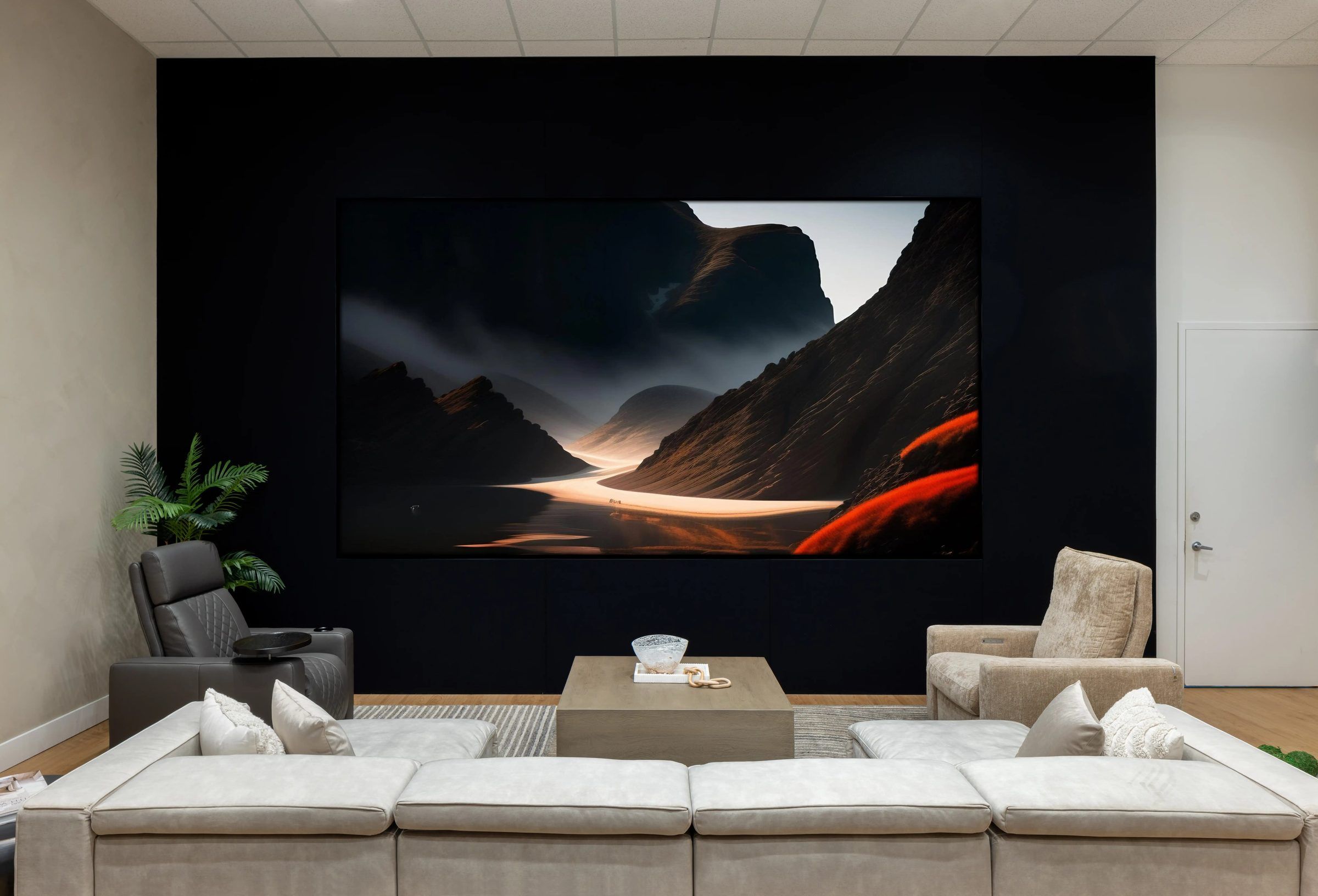
Why and how to calibrate a 98 inch or larger TV
By Adam Zell, Boston Automations | Published | Updated | 6 minute read
The short answer
Does a large TV need professional calibration?
It benefits more than a small one. At 98 to 115 inches, color errors, crushed shadows and motion artifacts are larger and easier to see. Calibration measures the screen in your room with a meter, sets white balance, gamma and HDR tone mapping, and creates separate day and night modes, so the picture looks like the filmmaker intended at any hour.
Why bigger screens need it more
Every television leaves the factory set to look bright in a store. In a home, that usually means colors that are too blue, shadows that are crushed or lifted, and processing that smooths faces and adds artificial motion. On a 55 inch screen you might not notice. On a 98 to 115 inch screen, the same errors are three or four times larger in area and much harder to ignore.
Size also changes how you watch. You sit closer relative to the screen, in a room built for it, often for an entire film. A slightly green gray or a skin tone that looks sunburned becomes distracting over two hours.
Choosing the starting picture mode
Before any measurement, the right mode does most of the work. Both Sony and Samsung offer accurate modes that disable the most aggressive processing. Sony also offers Studio Calibrated modes for services including Netflix, Prime Video and Sony Pictures Core, where available.
Whatever mode you use, a few settings make the biggest difference:
- Turn off motion smoothing for films, or set it to its lowest level.
- Turn off noise reduction for good sources such as 4K streaming and discs.
- Set the color temperature to the warmest preset as a starting point.
- Disable energy saving modes that dim the picture based on room light, unless you choose them on purpose.
What a calibration session covers
A professional calibration measures the television in your room with a color meter and software, then adjusts the set's own controls until the measurements match the industry standards the content was mastered to.
Those standards are published. For standard dynamic range video, the targets are the Rec. 709 color space, a D65 white point and the BT.1886 gamma curve used in dark mastering rooms. For HDR, the target is the PQ brightness curve defined in SMPTE ST 2084, with color carried in a BT.2020 container and usually mastered within the smaller P3 range.
| Step | What it fixes |
|---|---|
| Black level and brightness | Shadow detail that is lost or washed out |
| White balance | Grays that look blue, green or pink |
| Gamma | How quickly the image moves from dark to bright |
| Color management | Skin tones, skies and foliage that look wrong |
| HDR tone mapping | Bright scenes that clip or look dim |
| Uniformity check | Visible patches or tints across a large panel |
The uniformity check matters more on a large panel. If we find a problem the controls cannot correct, we raise it with the manufacturer while the set is new.
Day and night modes
Large televisions in New England great rooms live in two different rooms: bright afternoons with sun off the snow or the water, and dark evenings with a few lamps. One setting cannot serve both.
We usually calibrate at least two modes. A day mode runs brighter, with gamma adjusted for ambient light. A night mode targets the standards used to master films, for a dark room. Both are labeled clearly, and in a home with a control system, we tie them to lighting scenes so choosing Movie dims the lights, closes the shades and selects the night picture together. Our lighting guide covers how those scenes are built.
HDR tone mapping
HDR films are often mastered for brightness levels no television fully reaches. The television has to map those highlights to what its screen can show, which is called tone mapping. Done badly, bright skies clip to white or the whole image looks dim.
Sony uses Dolby Vision metadata to guide this, alongside HDR10 and HLG. Samsung uses HDR10+ in place of Dolby Vision. We check that HDR content tracks correctly from dark to bright on your exact set. In a reference system, a madVR Envy processor can take over tone mapping, frame by frame, before the signal reaches the television.
Motion and processing
Film is shot at 24 frames per second. Televisions offer motion smoothing that inserts new frames, which makes films look like video. Most people who care about film turn it off. Sports and games are different, and a little motion processing can help with fast pans.
We set separate modes for each, so a game console, a sports channel and a film each get the right treatment without anyone opening a menu. For gaming, we confirm 4K at 120Hz, variable refresh rate and auto low latency mode are working end to end.
Sources and the signal chain
A calibrated television is only as good as what feeds it. On a 98 to 115 inch screen, the difference between a compressed stream and a high bit rate source is easy to see in dark scenes, skies and fine texture.
- Streaming players vary in how they handle frame rate and HDR. We set them to match the content's frame rate and dynamic range rather than forcing everything to one format.
- Kaleidescape downloads films at much higher quality than typical streaming, which shows on a screen this size.
- Cable and satellite boxes often send a fixed format. We calibrate the mode they use separately.
- HDMI extension between the rack and the screen must pass the full signal without dropping HDR or 4K at 120Hz.
We measure each important input, not just one, so the picture is right whichever source is playing.
When to calibrate and recalibrate
Calibrate once the room is finished: paint dry, shades installed, lighting programmed and the set run in for a while. A calibration done in a construction site will be wrong in the finished room.
After that, a check every year or two is sensible, and after any major firmware update that changes picture processing. Calibration belongs in the plan for any large format installation from the start. See our large format TVs page and our Sony and Samsung pages for the models we design with.
More questions
Can I calibrate a TV myself with a setup disc?
You can set brightness and contrast correctly with a test pattern disc, and choosing the right picture mode gets you most of the way. White balance, gamma and color need a meter and software, and the controls vary by model, so a full calibration is best done by someone with the equipment.
Do streaming calibrated modes replace calibration?
They help. Sony's Studio Calibrated modes for services such as Netflix and Prime Video, where available, set a faithful starting point for that content. They are factory settings, though, and cannot account for your room's light or your particular panel. Calibration measures both.
