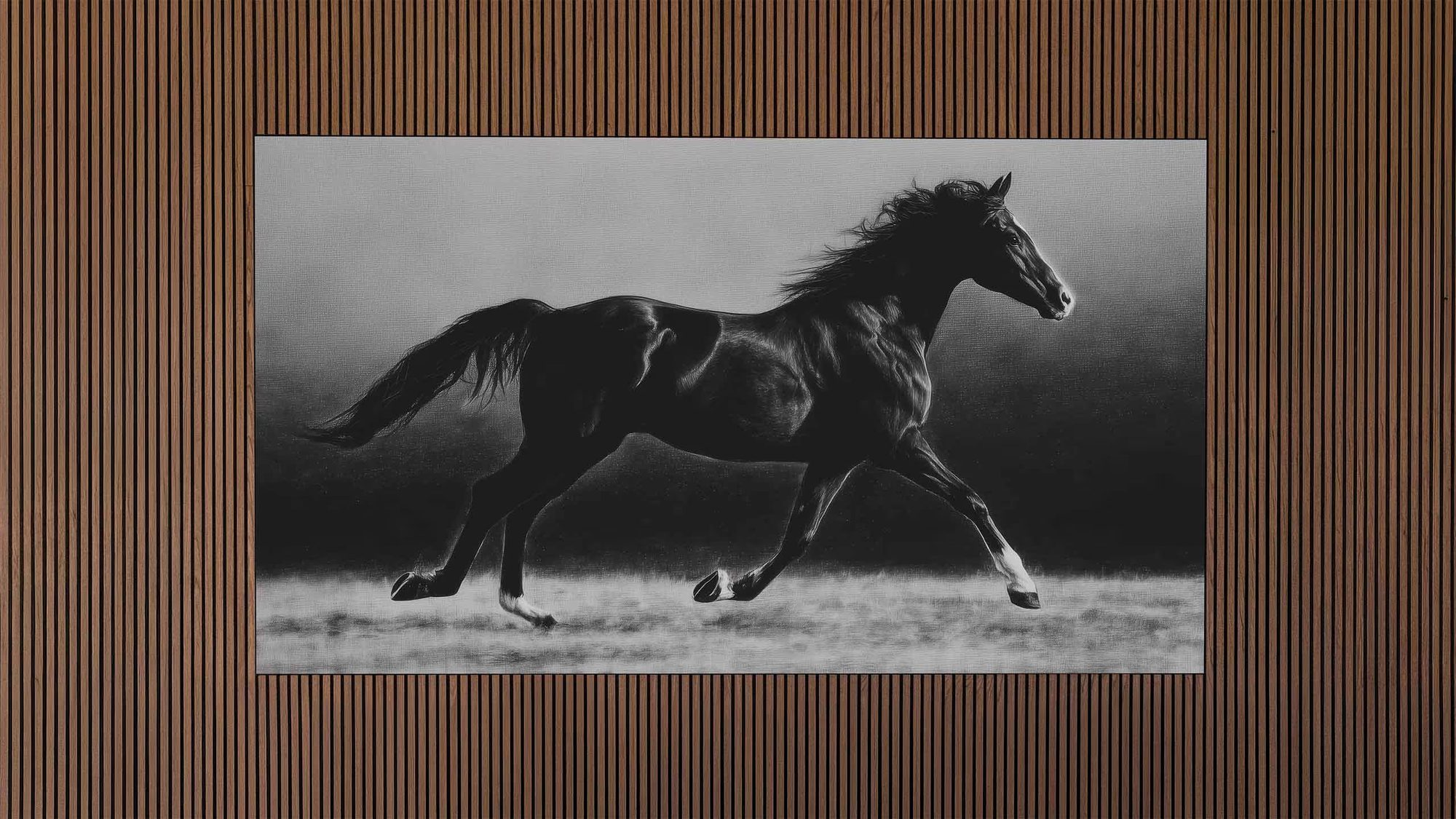
A video wall as a digital art canvas
By Adam Zell, Boston Automations | Published | Updated | 6 minute read
The short answer
Can a video wall display art when it is not showing TV?
Yes, and the best ones are designed for it. Eleusis Digital Canvas includes a Blackdove digital art subscription with its canvases, and its Gallery Series includes the Blackdove media server. Just Video Walls offers Camo mode in its Autograph line so the wall can match its surroundings. Brightness, schedules and framing decide whether the result looks like art or like a TV left on.
Why a resting state matters
A video wall in a living space is usually off for most of the day. During those hours it is the largest object on the most important wall in the room. Left as a dark surface, it can feel like a hole in the architecture. Designed properly, it can be the opposite: a place for art, or a surface that simply belongs to the room.
That is why we treat what the wall shows when it is not showing a film as a design decision, settled with the interior designer at the same time as the size and finish.
Three ways to treat a wall when it is off
| Approach | What you see | Suits |
|---|---|---|
| Art | Digital or moving art, changing on a schedule | Entry halls, dining rooms, great rooms |
| Blend in | A surface that matches or echoes its surroundings | Rooms where the architecture should lead |
| Dark | A matte, recessed surface framed by trim or millwork | Dedicated cinemas and media rooms |
Eleusis and Blackdove
Eleusis Digital Canvas builds its walls around art. The company calls them canvases, designs them to recess into the wall and sit almost flush, and puts an anti-glare finish on every one. It partners with Blackdove, a Miami based digital art platform that streams moving works by contemporary artists, and includes a year of Blackdove access with its canvases.
The Gallery Series goes further. It is designed for digital art and includes the Blackdove media server, so the canvas can play a curated collection without a separate player. Eleusis also describes settings that echo natural materials, such as stone or wood, for rooms where the wall should blend in rather than show a work.
Just Video Walls and Camo mode
Just Video Walls approaches the same problem from the other side. Its Autograph line, built for luxury homes, includes Camo mode, which lets the wall take on the look of its surroundings so it disappears when no one is watching. Paired with the company's Absolute Black contrast platform, which is exclusive to Autograph, a wall can read as deep and quiet when off and still deliver a cinema picture at night. See the Autograph line.
Settings and framing for art
An LED wall can be dazzlingly bright. Art should not be. The difference between a canvas that looks like a painting and one that looks like a television left on comes down to a handful of choices:
- Brightness matched to the room. A work on a canvas should be about as bright as a lit painting on the next wall, not as bright as a football game. We calibrate a dedicated art mode.
- Color that suits the light. Warmer settings in the evening, under warm lamps, and more neutral settings in daylight.
- A matte face. An anti-glare surface keeps reflections of windows and lamps off the work.
- The frame. A recess, a slim trim or a millwork surround that relates to the room, the way a frame relates to a painting.
- Proportion. Art does not have to be 16:9. Square and portrait proportions often look more like artwork than a television shape does.
- Schedules. The canvas wakes when the house does and turns off overnight and when you are away.
Pixel pitch matters more for art than for film, because people walk up to art and look closely. Our pixel pitch guide covers how to choose.
Sources, collections and care
Subscriptions. The simplest source is a curated platform. Blackdove, included with Eleusis canvases, streams a library of moving works and lets you build playlists from an app, so the art changes without anyone handling files.
Your own collection. Many collectors now own digital works, some as files and some as tokens tied to a file. Eleusis describes its Gallery Series as designed with digital and NFT art in mind. Before installation we work out how each work will be stored and played, what format and resolution it is in, and whether its license allows display on a screen of this size.
Photographs and paintings. High resolution images of photographs or paintings can look beautiful, but they need the same care a printer would give them: correct color, correct brightness and a size that respects the original proportions.
Resolution and shape. Works look sharpest when they are prepared at the canvas's native resolution and shown pixel for pixel. A square or portrait canvas does not match a 16:9 file, so a work made for a 3840 by 2160 screen is either cropped or shown with black bars. We confirm the exact pixel dimensions of the canvas before a piece is commissioned or bought.
Care over time. LEDs age gradually with use. Showing art at low brightness is gentle on them, and changing works regularly spreads use evenly across the canvas. A periodic check of color and uniformity keeps the canvas looking as it did on the first day.
Lighting around the canvas deserves the same attention as the canvas itself. A picture light or wall washer aimed at a painting will wash out a digital canvas, so we light the room around it instead and keep fixtures from shining directly on its face. Dimmed room light, not darkness, flatters a canvas most.
Where art canvases work best
- Entry halls and stair walls. The first thing guests see, and a place where art changes the mood of the house.
- Dining rooms. A canvas behind the table, set to something calm for dinner.
- Great rooms. The same wall shows art by day and films or sport at night.
- Primary suites and libraries. Smaller canvases, set very dim, as living pictures.
We plan art canvases with interior designers and architects through our design services. Tell us about the wall you have in mind.
More questions
What kind of art looks best on an LED canvas?
Work made for screens: slow moving digital pieces, generative art and video art. High resolution images of paintings and photographs also look good when brightness and color are set carefully for the room.
Does showing art all day use a lot of power?
Art is usually shown at a small fraction of the wall's maximum brightness, so it draws far less than a bright film or game. Schedules that turn the canvas off overnight and when the house is empty reduce it further.
Can the art change by time of day?
Yes. We can schedule playlists through the art platform and the control system, for example quiet works in the morning and something more vivid for an evening party.
