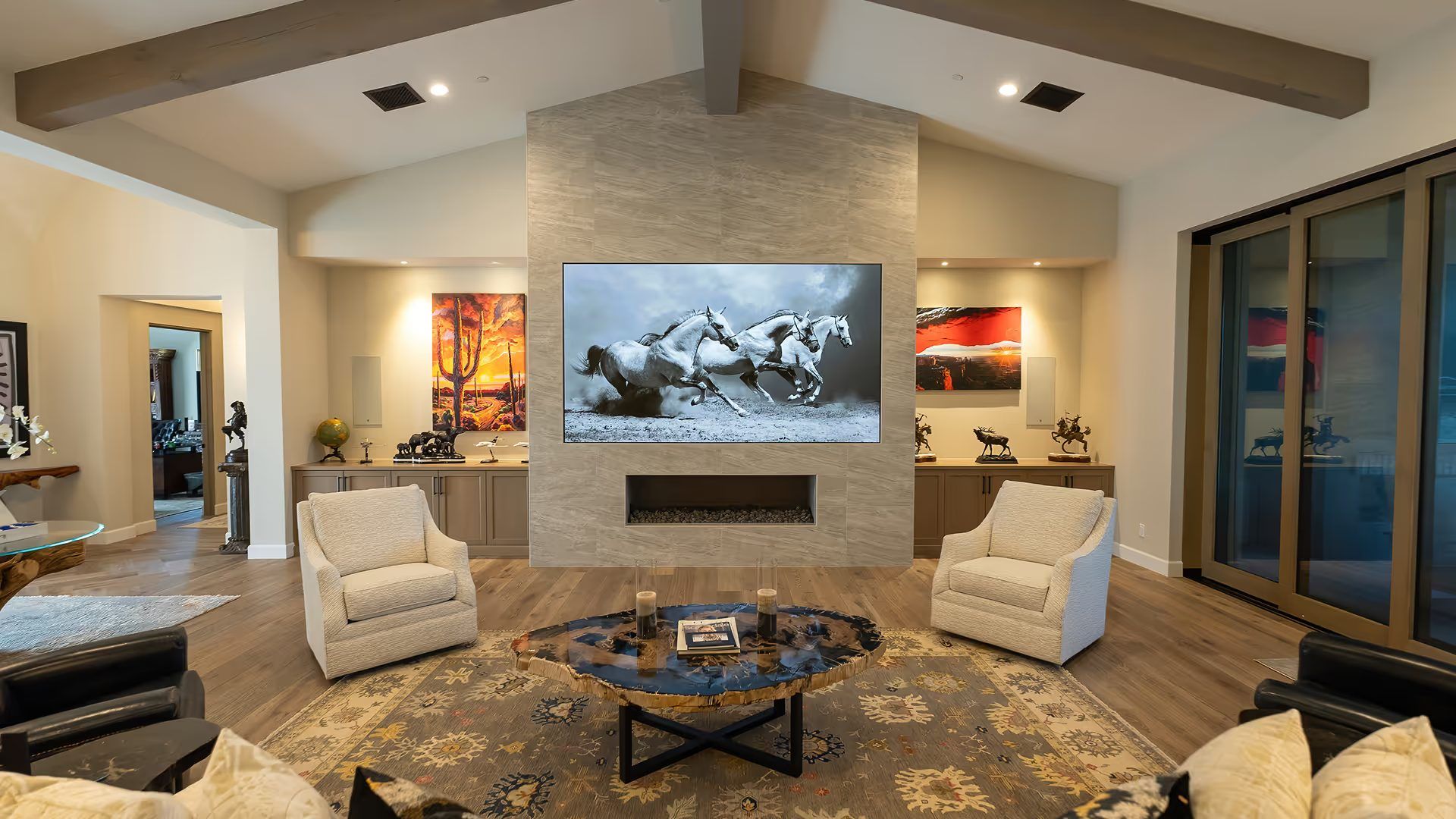
Pixel pitch and viewing distance for a home LED wall
By Adam Zell, Boston Automations | Published | Updated | 7 minute read
The short answer
What pixel pitch do I need for a home video wall?
Match pitch to your closest seat. A common rule of thumb puts the comfortable minimum distance in feet at about ten times the pitch in millimeters. A family room with seats about nine feet away suits roughly 0.9mm, a gaming room with closer seats suits 0.7mm, and walls viewed from twelve feet or more can use 1.2mm or coarser.
What pixel pitch means
Pixel pitch is the distance from the center of one pixel to the center of the next, measured in millimeters. On an LED wall each pixel is a cluster of red, green and blue LEDs, and the pitch tells you how tightly those clusters are packed. A 0.9mm wall has its pixels less than a millimeter apart. A stadium screen might have them ten or more millimeters apart.
Pitch is the most important number on a video wall specification. It decides how close you can sit before you notice the pixel structure, how many pixels a wall of a given size contains, and a large share of what the wall costs.
How close can you sit?
There is no single industry standard, but there are well known rules of thumb. The one we use as a starting point is the ten times rule: multiply the pitch in millimeters by ten to get a comfortable viewing distance in feet. Planar, a large LED manufacturer, describes it as roughly the distance at which a person with normal vision stops resolving individual pixels.
Other published rules are more forgiving. Barco, for example, suggests an optimal distance in meters of about twice the pitch in millimeters, which works out to roughly six and a half feet per millimeter. In practice, a wall can look very good a little closer than the ten times rule, especially with film and sport, and we treat the rule as a comfortable target rather than a hard limit.
Pitch, distance and 4K wall size
| Pitch | Comfortable distance (10x rule) | 4K wall size at this pitch | Typical use |
|---|---|---|---|
| 0.7mm | About 7 feet | About 121 inches diagonal | Gaming rooms, close seating, smaller lounges |
| 0.9mm | About 9 feet | About 156 to 163 inches | Family rooms and media rooms |
| 1.2mm | About 12 feet | About 208 to 217 inches | Larger rooms and theaters, outdoor living |
| 1.5mm | About 15 feet | About 260 inches | Very large walls and distant seating |
The size column assumes a native 3840 by 2160 wall. The ranges reflect rounding: 0.9mm walls often measure 0.9375mm, and 1.2mm walls often measure 1.25mm. Just Video Walls showed a 217 inch, 4K wall at 1.2mm pitch at CEDIA Expo 2025, which matches the upper figure.
How pitch sets the size of the wall
Because every pixel has a fixed spacing, the pitch and the resolution together decide the physical size. A 4K picture is 3840 pixels wide. Multiply that by the pitch and you have the width of the wall. At 0.9375mm that is 3.6 meters, about 142 inches wide. At 1.25mm it is 4.8 meters, about 189 inches wide.
Put another way, a 0.9375mm wall has about 27 pixels per inch and a 1.25mm wall about 20. A 4K television of 98 inches has roughly 45, so it can be watched from closer. Both are 4K; the wall simply spreads the same pixels over a larger area.
This has three practical consequences:
- A smaller 4K wall needs a finer pitch. If your wall is 120 inches diagonal and you want native 4K, you need roughly 0.7mm.
- A wall smaller than its native size runs below 4K. A 1.2mm wall built to 150 inches has fewer than 3840 pixels across, and the processor scales the picture to fit. That can look excellent from the right distance, but it is worth knowing.
- A very large wall can exceed 4K. Some walls have more pixels than any source provides, and the processor scales up. Good processing makes this invisible.
Content and pixel pitch
Film and live sport are forgiving. Motion, grain and natural images hide pixel structure, and a wall looks smooth a little closer than the rule suggests. Fine text, menus, spreadsheets and the heads up display of a video game are not forgiving. If the wall will double as a computer display or a gaming screen with seats close by, go finer.
Art is a special case. A still or slow moving image invites people to walk up and look closely. For a digital art canvas in a hallway or dining room, where guests will stand a few feet away, we lean toward the finest pitch the budget allows. See video walls as digital art.
Is a finer pitch always better?
A finer pitch packs many more LEDs into each square foot. A 0.9mm wall has about 115,000 pixels per square foot, a 1.2mm wall about 64,000 and a 1.8mm wall under 29,000. More LEDs mean more cost, more processing and, at a given size, often more power and heat.
If your nearest seat is fourteen feet from the wall, paying for 0.7mm buys detail no one in the room can see. That budget is usually better spent on size, sound or calibration. The right pitch is the coarsest one that looks smooth from your closest seat. Our cost guide explains how pitch drives price.
The same logic applies outdoors, where seats are often further away and pitches are usually coarser. Just Video Walls introduced outdoor walls at 0.9mm and 1.2mm at CEDIA Expo 2025, fine enough for a terrace sofa rather than only a lawn.
How we choose pitch
- We draw the seating plan and measure the distance from the nearest seat to the wall.
- We ask what the wall will show most: film, sport, games, art or a computer desktop.
- We set a pitch that looks smooth from that seat for that content.
- We size the wall to the room and the viewing angle, then check what resolution that size gives at the chosen pitch.
- Where possible, we look at a sample of the chosen pitch from your seating distance before you commit.
Room size and seating distance are planned together, as our room size guide explains. For the wider picture, see what a MicroLED video wall is or the video walls page.
More questions
Is a 0.9mm wall the same as 0.9375mm?
Usually they are the same product described two ways. Manufacturers often round pitch in marketing, so a wall sold as 0.9mm may measure 0.9375mm, and one sold as 1.2mm may measure 1.25mm. The exact figure matters when calculating the size of a 4K wall.
Can I mix pixel pitches in one wall?
Not in a single picture. Every panel in a wall shares one pitch so the image is uniform. Different rooms in the same house can, and often should, use different pitches.
Does pitch affect brightness?
Indirectly. Brightness depends on the LEDs, the drive electronics and the surface finish. Outdoor walls are built for much higher output than indoor walls, regardless of pitch.
