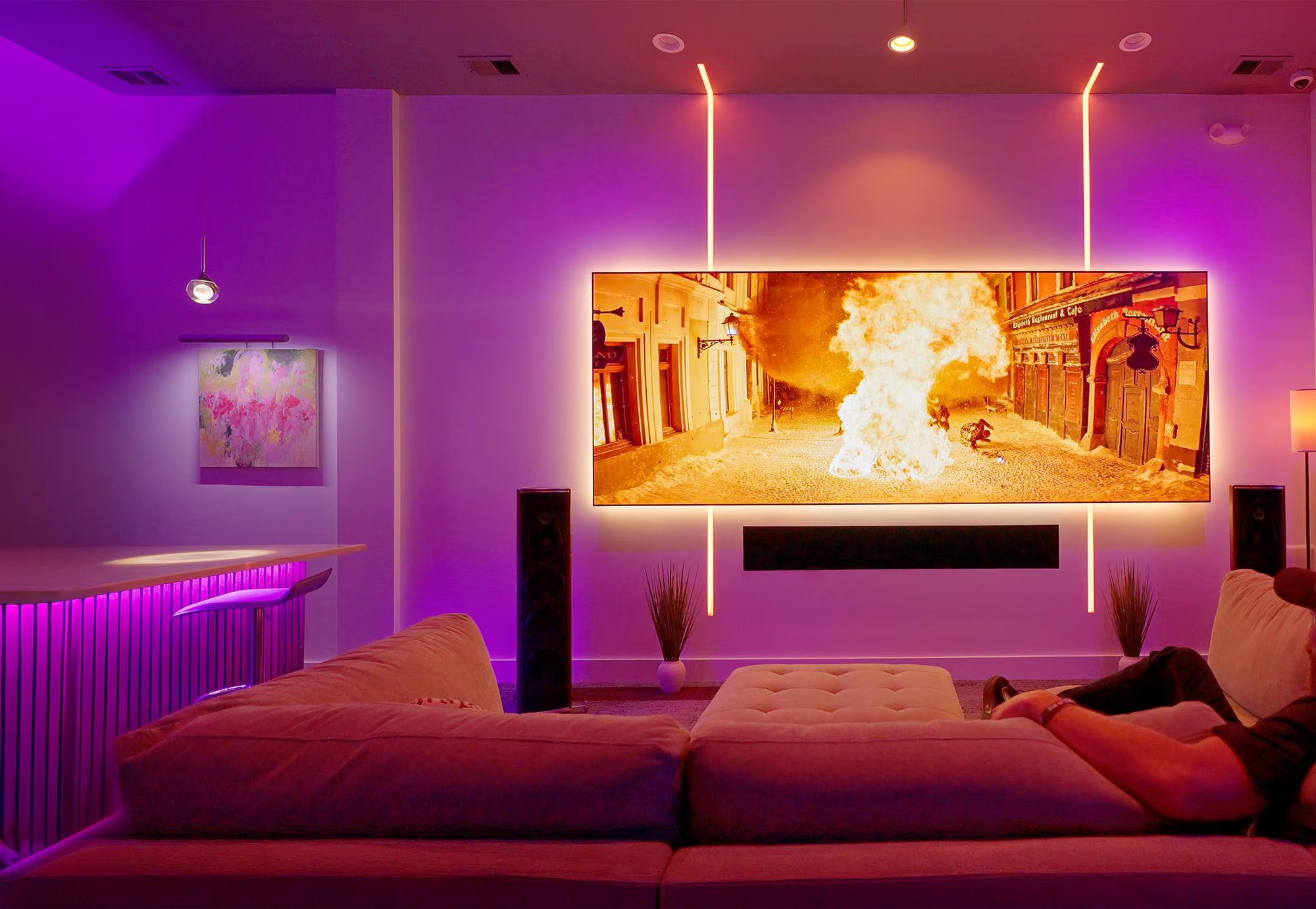
A video wall or a very large TV?
By Adam Zell, Boston Automations | Published | Updated | 6 minute read
The short answer
Should I buy a video wall or a giant TV?
If a 98 to 115 inch screen fills enough of your view from the seats, a large TV is simpler, faster to install and far less expensive. Choose a video wall when you want a picture bigger than any TV, a size or shape built for the room, or a screen that blends into the architecture or shows art when it is off.
The short answer
Televisions now reach 98 to 115 inches, and for many rooms that is plenty. They are bright, they handle daylight, they arrive in a box and they cost a small fraction of an LED wall. If a screen that size fills enough of your view from where you sit, buy the television.
Choose a video wall when you want more than a television can give: a picture larger than 115 inches, a size or shape that fits the architecture exactly, a screen that sits flush and blends into the wall, or a surface that shows art when it is not showing a game. Our large format TVs page covers the Sony and Samsung models we install.
Is 115 inches enough?
The test is the angle the screen fills from your seat, not the number on the box. Industry guidance for cinema suggests a viewing angle of roughly 30 to 40 degrees, and many people who love films prefer more. Here is roughly what a 16:9 screen fills from common family room distances.
| Screen | From 10 feet | From 12 feet | From 14 feet |
|---|---|---|---|
| 98 inch TV | About 39 degrees | About 33 degrees | About 29 degrees |
| 115 inch TV | About 45 degrees | About 38 degrees | About 33 degrees |
| 160 inch wall | About 60 degrees | About 52 degrees | About 45 degrees |
From ten feet, a 98 inch television already sits in the cinema range. From fourteen feet, it starts to feel like a window across the room, and a wall begins to earn its place. In a large great room, where the sofa is often fourteen feet or more from the fireplace wall, that difference is the whole argument.
Side by side
| 98 to 115 inch TV | MicroLED video wall | |
|---|---|---|
| Size | Fixed sizes up to about 115 inches | Built to the wall, about 100 inches and up |
| Shape | 16:9 | 16:9, cinema widths, square or custom |
| Delivery | One large carton, two or more people to lift | Panels, mounting structure and processor, assembled on site |
| Building work | Blocking, power and signal | Structure, dedicated circuits, cooling and service access |
| Repairs | Whole set, usually | Panel or module level |
| Relative cost | Lower | Much higher |
Installation and logistics
Very large televisions have a logistics problem that is easy to overlook: the carton. A 98 inch or larger set ships in a box that has to come through doors, up stairs and around corners in one piece. In an older New England house with a narrow stair or a tight turn, that can decide the matter. Video wall panels arrive in manageable cases and are assembled where they will live.
On the other hand, a wall asks much more of the building. It needs a flat, strong mounting surface, its own circuits, a plan for heat and a way to service panels. A television needs good blocking, power and a clean path for signal. Our installation guide explains what a wall needs.
Picture quality and everyday use
At the top of the market, both are excellent, and the differences are about character rather than quality. Premium televisions are tuned at the factory, arrive with their own processing and streaming apps, and look very good out of the box. A video wall is a system: the panels, the processor and the calibration together decide how it looks, and a wall that has been carefully calibrated on site can be extraordinary.
Everyday use differs too. A television turns on with its own remote and plays its own apps. A wall takes its picture from external sources, such as a film server, a streaming player or a cable box, routed through the control system. In a well designed home that is invisible, since one remote or keypad runs everything. It does mean the wall depends on good integration in a way a television does not.
Uniformity is the thing to watch on a wall. Panels must match each other in color and brightness, and the best walls are calibrated so the seams vanish. We check uniformity at commissioning and keep spare modules from the same batch for repairs.
When the screen is off
A large television, switched off, is a large dark rectangle. Good design can frame it in millwork or hide it behind panels, but it is still there. A video wall can do something different. It can sit almost flush with the surrounding surface, take on a finish that suits the room, or show art. Eleusis Digital Canvas builds its walls around showing digital art from Blackdove, and Just Video Walls offers a Camo mode in its Autograph line that lets the wall match its surroundings.
For rooms where the screen is the focal wall of the house, that resting state can matter as much as the picture. See video walls as digital art.
There is also a middle path. Some homes put a large television in the family room and a video wall in the one room where it matters most, such as the great room or the lower level lounge. Others start with a television and rough in the structure and power for a wall later.
How we help you choose
We measure the seating distance, the wall and the light in the room, then sketch both options at true scale. Often the answer is clear once you see a 115 inch television and a 160 inch wall drawn on the same elevation. When a television is the right answer, we say so. When the room wants more, we design the wall into the architecture.
See our media rooms and video walls pages, or tell us about your room.
More questions
Can a 98 inch TV be recessed into a wall?
Yes. With the right mount, blocking, ventilation and an accessible power and signal location, a large TV can sit in a shallow niche or flush with millwork. We check the manufacturer's ventilation clearances before drawing the niche.
Is a video wall harder to replace or upgrade than a TV?
Different rather than harder. A TV is replaced whole. A video wall is serviced panel by panel, and the processor can be updated separately. Upgrading to a finer pitch means replacing the panels on the same structure.
