Where subwoofers go and how they are blended in
By Adam Zell, Boston Automations | Published | Updated | 7 minute read
The short answer
Where should subwoofers go in a home theater?
Common starting points are the front corners, the middle of the front and back walls, or the middle of the side walls, chosen to suit the seating. The best positions are found by modeling the room and confirming with measurements across every seat. Then crossover, timing, level and room correction blend the subwoofers with the main speakers.
Common starting positions
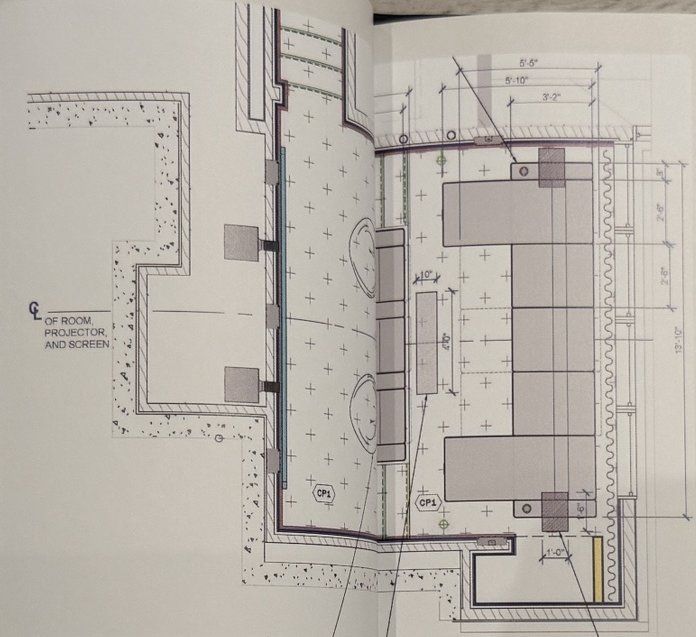
Where a subwoofer sits changes which room modes it excites, which changes the bass you hear in each seat. A few layouts are well known for producing even results in rectangular rooms, and they are where we start:
- Two subwoofers, middle of the front and back walls. Opposite positions tend to cancel some of the strongest front to back modes.
- Two subwoofers, middle of the side walls. Useful when the screen wall has no room and the side walls do.
- Four subwoofers, one in the middle of each wall or one in each corner. Both give very even coverage in rectangular rooms.
- Two front corners. Simple, high output and easy to hide behind a screen, though often less even than the options above.
Real rooms are rarely perfect rectangles. Openings, soffits, risers and a door in the wrong place all change the result, so these layouts are starting points, not answers.
Modeling before construction
Once the room dimensions and seating plan are set, we model how different subwoofer positions will behave at each seat. That tells us which walls and locations to reserve, and it lets the builder frame for them before drywall. It is much easier to block and wire a wall for a subwoofer during framing than to open it later.
Modeling also shows how many subwoofers the room needs. Our guide to how many subwoofers a theater needs explains the reasoning.
Bass management and crossovers
A film soundtrack has two kinds of bass. The low frequency effects channel, the .1, carries dedicated effects meant only for subwoofers. The main channels also carry bass, sometimes a lot of it. Bass management in the processor takes the low bass from every channel and sends it to the subwoofers, so each speaker only plays what it handles well.
The point where bass moves from the speakers to the subwoofers is the crossover. 80 Hz is the common starting point. Speakers with strong bass of their own may cross lower, and small in-ceiling speakers may cross higher. The goal is a hand-off you cannot hear: no gap, no bump, and no sense that the bass comes from a box in the corner.
| Setting | What it does | How we set it |
|---|---|---|
| Crossover | Divides bass between speakers and subwoofers | From each speaker's capability, confirmed by measurement |
| Delay | Aligns arrival time from each subwoofer and speaker | Measured at the seats, not just from tape measure distance |
| Phase | Makes subwoofers and speakers add together at the crossover | Measured and adjusted for the smoothest combined response |
| Level | Balances bass against the rest of the system | Calibrated to reference, then fine tuned by ear |
Timing, phase and level
Every subwoofer is a different distance from each seat, and subwoofers have their own internal delay from their electronics and filters. If the bass from the subwoofers and the bass from the speakers arrive out of step, they partly cancel right at the crossover. That is why we set delay and phase from measurements rather than distances.
Level is the final piece. A little more bass than a flat calibration gives is a reasonable choice. We calibrate to a reference first, then adjust with you so the result suits the films and music you love.
Room optimization and correction
Room correction works in layers. JL Audio subwoofers include D.A.R.O., Digital Automatic Room Optimization, which uses a supplied calibrated microphone to correct each subwoofer's response in the room. The processor then corrects the whole system.
StormAudio processors include Dirac Live, Dirac Bass Control and Dirac Live Active Room Treatment. Bass Control adjusts the subwoofers and speakers so they combine evenly across the seats. ART goes further, coordinating all capable speakers and subwoofers to reduce room resonances. Our Dirac guide goes into detail.
Correction works best on a room that is already designed well. Good subwoofer positions and acoustic treatment give the software less to fix, so the result sounds natural.
LFE and bass managed bass
It helps to separate two ideas. The LFE channel is a dedicated effects track, recorded with extra headroom, that only subwoofers play. Bass managed bass is the low end taken from the main channels and redirected to the subwoofers. In a calibrated system both arrive at the subwoofers together, and the subwoofers must handle both at once without strain. That combined load is why we size subwoofers with generous headroom.
Hiding the subwoofers
In dedicated theaters, subwoofers sit behind the acoustically transparent screen, inside the screen wall, or behind acoustic fabric in the side and rear walls. Grilles and cabinet fronts need to pass bass freely, and anything near the subwoofer needs to be rigid so it does not buzz.
In living spaces we use in-wall subwoofers such as the JL Fathom IWSv2-SYS-213, or James PowerPipe X models that sit in the ceiling or a cabinet and vent through a small grille or toe kick.
Hiding a subwoofer should never change where it goes. The position comes from modeling and measurement first, and the enclosure, fabric panel or cabinet is designed around it afterward. A cabinet also needs clearance around the driver and any port, with the port opening into the room rather than into a closed cavity, or the subwoofer loses output and can add resonances of its own.
Checking by ear
After the measurements, we listen. We play familiar scenes and music in every row and listen for boom, gaps, rattles and bass that seems to come from one corner. Anything that buzzes, from a sconce to a door, gets fixed. Good bass should feel powerful and tight, and it should never draw attention to where it comes from.
We also revisit the bass a few weeks after handover if you want. Once the room is furnished and people have lived with it, small adjustments to subwoofer level or the target curve can make it feel exactly right.
More questions
What is the subwoofer crawl?
An old trick: put the subwoofer in your seat, crawl around the room, and place it where the bass sounds best. It can help with one subwoofer and one seat. With several subwoofers and several rows, modeling and measurement across all seats give far better results.
Should subwoofers face the seats?
For the frequencies a subwoofer plays, direction matters very little because the waves are much larger than the cabinet. Position in the room matters far more. We orient subwoofers for the best fit and finish, then measure.
Can subwoofers sit inside the riser?
Sometimes. A riser can hold subwoofers or tactile transducers, but it can also rattle and boom if it is not built for it. We decide during design whether the riser is a good location and detail its construction accordingly.
