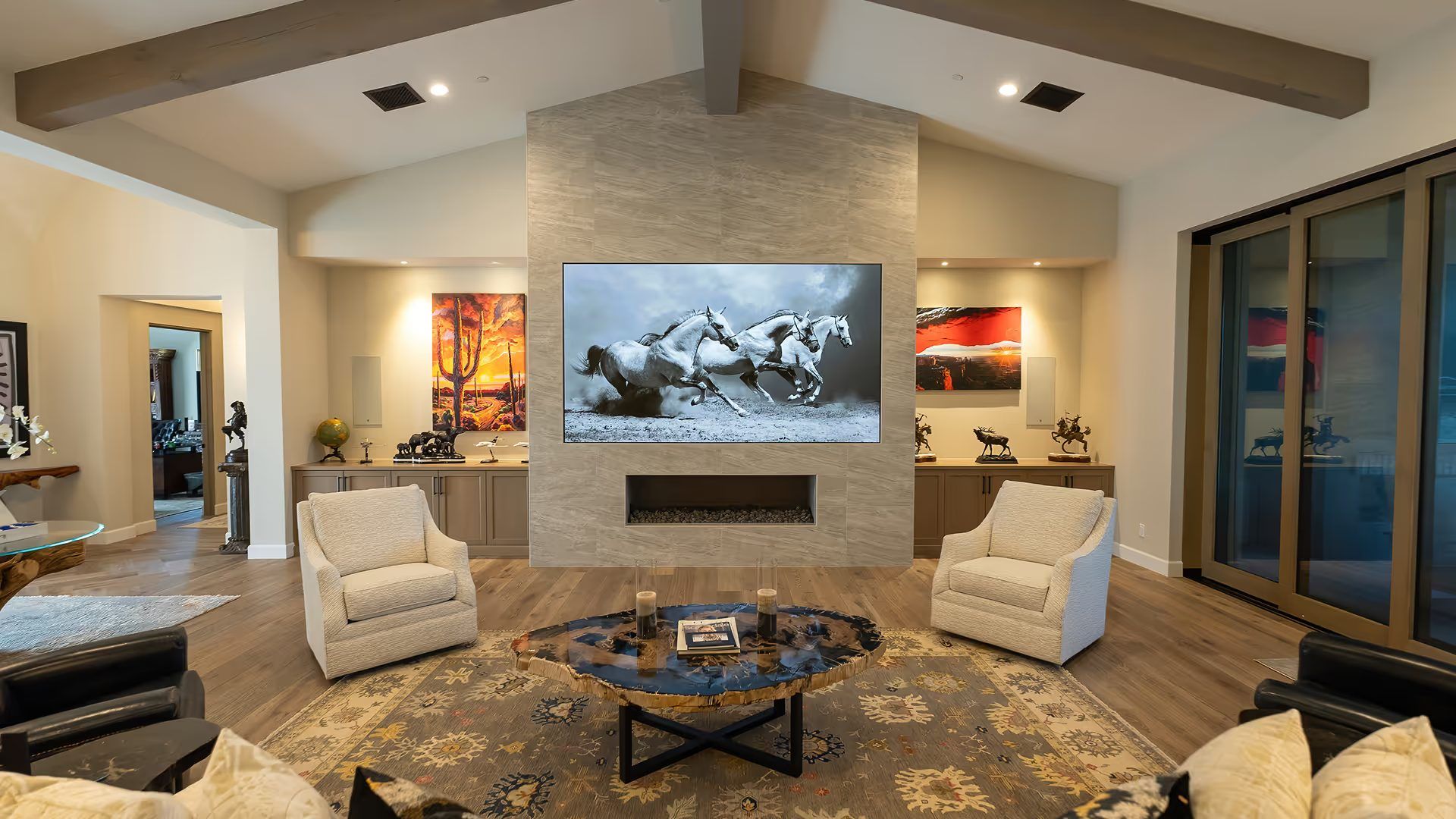
Designing sound around a video wall
By Adam Zell, Boston Automations | Published | Updated | 7 minute read
The short answer
Where do speakers go with an LED video wall?
Around the wall, because sound cannot pass through LED panels. The left and right speakers usually sit in the wall beside the image, the center sits just below or above it, or all three live in a custom bar along the edge. Surrounds, overhead speakers and subwoofers are placed as in any theater, then the system is calibrated so dialogue sounds anchored to the picture.
Why a video wall changes the speaker plan
In a projection theater, the left, center and right speakers sit behind an acoustically transparent screen. Sound passes through the woven or perforated surface, and dialogue comes from the faces on screen. An LED wall is a solid surface covered in electronics. Sound cannot pass through it, so the front speakers have to go somewhere else.
That is not a reason to avoid a wall. It is a reason to design the sound at the same time as the wall, rather than fitting speakers into whatever space is left.
Where the front speakers can go
- In the wall beside the image. Left and right speakers in the wall on either side, at about ear height. This is the most common choice and the best for stereo imaging.
- Above or below the image. The center speaker sits in the wall directly below or above the picture. Below is usually better because it keeps dialogue close to the faces on screen and at a natural height.
- A custom bar along the edge. Left, center and right channels in one long enclosure, sized to the width of the wall and finished to match its trim. At CEDIA Expo 2025, Just Video Walls paired a 217 inch wall with a custom Leon Speakers soundbar to show the idea at full scale.
- Freestanding speakers. Floor standing speakers in front of the wall. Excellent sound, but they sit in front of the picture and are rarely right for a living space.
- Within a baffle wall around the wall. In a dedicated cinema, the whole front wall can be built as a baffle with the LED wall set into it and the speakers flush around it.
Width sets limits too. Dolby's home theater guidelines place the left and right speakers between 22 and 30 degrees either side of the main seat. On a very wide wall seen from close seats, speakers at its outer edges can fall well outside that range, so the left and right may sit in a bar above or below the image, inside its outer edges, rather than out at the corners.
Comparing the options
| Approach | Looks | Dialogue | Best for |
|---|---|---|---|
| In-wall left and right, center below | Clean, grilles can be painted | Very good | Great rooms and media rooms |
| Custom bar along the edge | Reads as part of the wall trim | Very good | Wide walls in living spaces |
| Baffle wall with flush speakers | Fabric or panel finish around the image | Excellent | Dedicated cinemas |
| Freestanding speakers | Visible furniture | Excellent | Listening rooms where looks come second |
Getting dialogue to come from the screen
The center channel carries most of the dialogue, and our ears are very good at noticing when a voice comes from below a face rather than from it. A few things close that gap.
- Keep the center close to the image. A center speaker tight to the bottom edge of the wall sounds far more convincing than one on the floor.
- Aim it. Angling the center toward the main seats, or choosing a speaker with controlled vertical dispersion, keeps dialogue focused.
- Match the three front speakers. When left, center and right share the same drivers and voicing, sound pans across the wall without changing character.
- Calibrate. Room correction and careful level and timing adjustment from a capable processor pull the sound image up toward the picture.
Surrounds, height speakers and bass
Everything behind the front wall works as in any theater. Surround speakers sit beside and behind the seats, and height speakers in the ceiling carry Dolby Atmos overhead effects. Our Dolby Atmos layout guide explains the common layouts.
Subwoofers are not tied to the screen, so they go where the room sounds best: often in the front wall corners, in the side walls or in cabinetry. Two or more subwoofers smooth out bass across the seats. In a living space, they can hide in millwork beside the wall.
Large hard surfaces affect the room's sound too. An LED wall is reflective, so in a dedicated room we balance it with acoustic treatment on the side walls and rear. See acoustics.
Living rooms and dedicated cinemas
In a living room or great room, the speakers have to live with the architecture. In-wall speakers with paintable grilles, aligned with the edges of the wall and the lines of the millwork, all but disappear. A custom bar can be finished to match the trim. Subwoofers hide in cabinetry. The aim is a room that looks like a beautiful room first and a theater only when the lights go down.
In a dedicated cinema, the whole front wall can be designed for sound. A baffle wall puts the front speakers and subwoofers into one rigid, acoustically treated surface with the LED wall set into it, and fabric or panels cover everything but the picture. Speakers can be larger, placed closer to the edges of the image, and calibrated for one listening position or several rows. Our private cinemas page shows how we approach these rooms.
In both cases, the number of rows matters. A single sofa can be served by speakers aimed at one area. Two or three rows need speakers and bass designed so every seat hears a balanced picture, which is easier to achieve when the room is drawn with the seating plan from the start.
Designing the wall and speakers together
The best rooms treat the front wall as one composition: the LED wall, the speaker grilles or bar, the trim and the cabinetry. We draw them together on the front elevation, so the wall width, speaker spacing and seating plan agree before framing begins. The speaker cutouts and back boxes then go into the construction drawings with the wall's structure and power.
For speakers we pair with video walls, see home theater audio. For the wall itself, see video walls, or tell us about your room.
More questions
Can I use a soundbar with a video wall?
Yes, but an off the shelf soundbar is usually too small for the scale of a wall. A custom bar sized to the wall's width, with proper left, center and right channels, is a better fit. Just Video Walls showed a 217 inch wall with a custom Leon Speakers soundbar at CEDIA Expo 2025.
Do invisible speakers work with a video wall?
Speakers that sit behind plaster or a finished surface can work well for surrounds and height channels in rooms where any grille is unwelcome. For the main front speakers beside a large wall, we usually prefer conventional in-wall designs for output and clarity.
