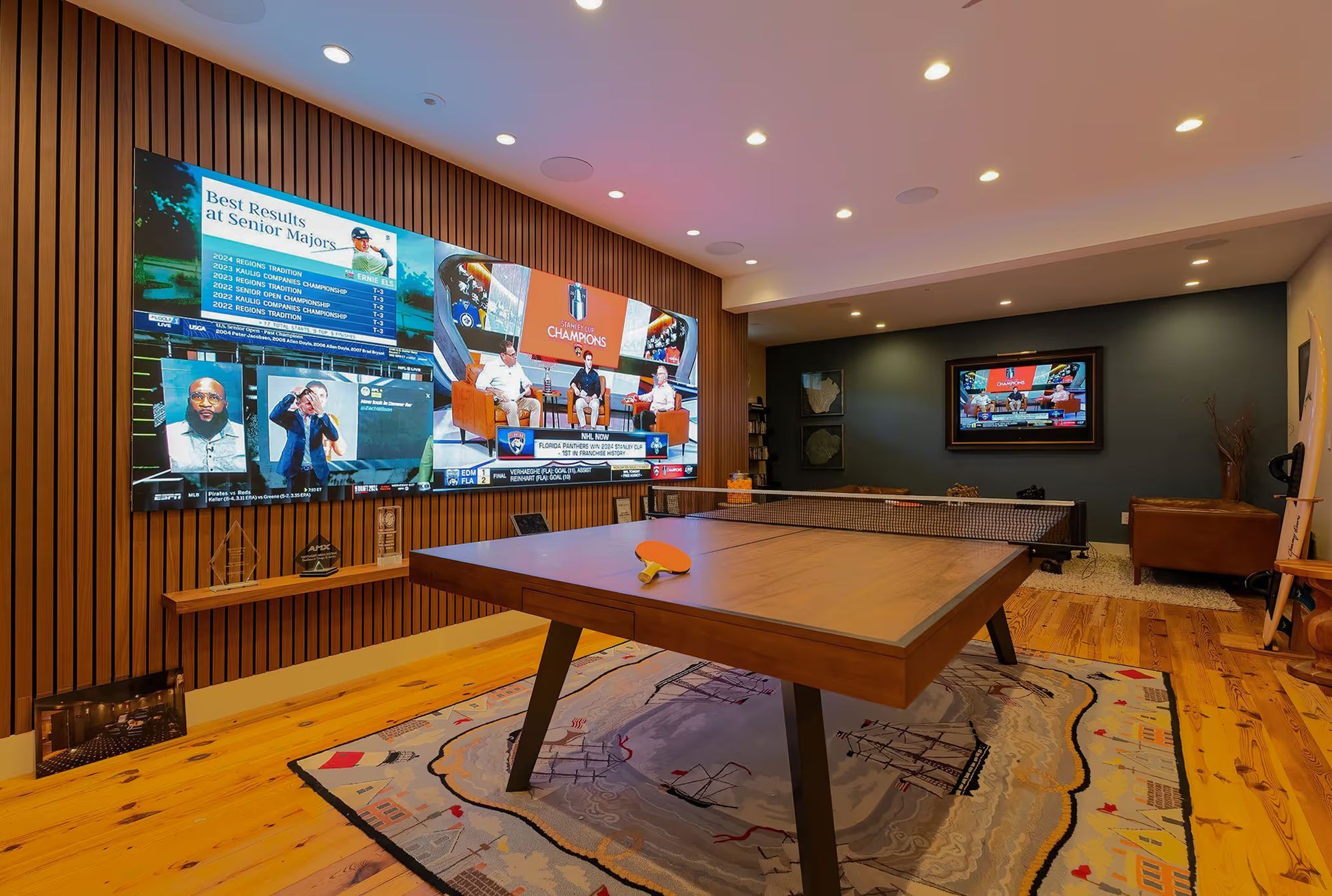
Gaming and sports on an LED video wall
By Adam Zell, Boston Automations | Published | Updated | 6 minute read
The short answer
Is an LED video wall good for gaming and sports?
Very good, if it is planned for them. Sport benefits from the brightness and size, especially in rooms with daylight, and a wall can show several games at once. Gaming needs a fine pitch for close seats, low processing delay and a signal path that keeps up with modern consoles and PCs. Those choices are made in design, not after.
Why walls suit games and sport
Sport and games are watched in daylight, with the lights on, by groups of people sitting at different distances. That is exactly where projection struggles and where an LED wall is strongest. A wall stays bright and colorful with the shades open, it can be large enough that everyone in the room has a good view, and it can show more than one thing at once.
The two uses ask slightly different things of the wall, so we look at each.
Watching sport on a video wall
Brightness. Afternoon games happen in afternoon light. A wall's brightness means nobody needs to close the shades on a fall Sunday, and the picture holds up in rooms with walls of glass.
Size and viewing angle. Sport is often watched from further back than film, with people standing at a bar or moving around. A larger wall at a slightly coarser pitch can serve the whole room better than a smaller wall at a very fine one.
Several games at once. Video wall processors can divide the wall into windows, each showing a different source. Lunar Walls, a brand from Just Video Walls, describes its Expanse walls as having up to 32 content layers built into the processing, depending on model, and Just Video Walls introduced a visual source management interface at CEDIA Expo 2025 to make layouts easy to manage. On a wide wall, one large game with three smaller ones beside it is a natural layout for a Saturday in college football season or the first round of the tournament.
Wide shapes. Very wide walls work well here. A 32:9 wall holds two full 16:9 pictures side by side, or one game with stats and other games around it.
Gaming on a video wall
Pitch for close seats. Gamers sit closer than film viewers, and game interfaces are full of small text and fine lines. A finer pitch is worth it here. Just Video Walls presented its 0.7mm indoor wall at CEDIA Expo 2025 with close range rooms such as gaming rooms in mind. Our pixel pitch guide explains the trade offs.
Processing delay. Every processor adds some delay between the console and the picture, and in fast games that delay matters. Delay depends on the processor, its settings and how many layers it is handling. We ask the manufacturer for the figures for your configuration and set a dedicated game mode that bypasses unnecessary processing.
Frame rate and signal path. Current consoles such as PlayStation 5 and Xbox Series X can output 4K at 120Hz over HDMI 2.1, with variable refresh rate, and gaming PCs can go higher. The source, the switching, the cabling and the processor all have to support the format you want, so we design the signal path end to end rather than assume it.
Motion. LED walls can render fast motion cleanly, and refresh rates vary by panel and processor. We check how a given wall handles fast panning and camera motion as part of choosing it.
Comfort during long viewing sessions
A wall bright enough for midday can be tiring by the fourth quarter, once the sun goes down. We calibrate separate modes for day and evening and tie them to the lighting scenes, so the wall dims as the room does. For gaming, where sessions run long and seats are close, a slightly lower brightness and a well lit room behind the players reduce eye strain. Sitting close to a very large wall can also mean turning your head to follow the action, so for close seats we keep the wall in proportion rather than as large as the room allows.
Audio delay matters as much as picture delay. When the picture is processed, the sound has to be held back by the same amount so dialogue and footsteps stay in sync, and the sound processor and video wall are set up together to do that.
What to plan for each
| Consideration | Sport | Gaming |
|---|---|---|
| Pixel pitch | Can be coarser if seats are further back | Finer, for close seats and small text |
| Brightness | High, for daylight | Moderate, comfortable for long sessions |
| Processing | Multiple windows and inputs | Low delay, high frame rate path |
| Shape | Wide formats for several games | 16:9 or ultra wide, to suit the games played |
| Seating | Sofas, bar and standing room | Closer, centered seats |
The room around the wall
Games and sport rooms are social. Plan sound that is clear at party volume and does not carry through the whole house, with subwoofers that hit hard without shaking the kitchen. Plan lighting scenes for a game, a party and a quiet night. And plan for sources: streaming players, cable or satellite, consoles and a PC, each with a home in the equipment rack and a place in the remote.
Many of these rooms are lower level spaces with a bar and a pool table. Our media rooms page shows how we design them, and our sound guide covers speakers around a wall.
How we plan a games and sports room
- List who uses the room, what they watch and play, and from where they sit or stand.
- Choose pitch from the closest regular seat and the content with the finest detail.
- Size and shape the wall for the main seating and for the layouts you want on game day.
- Design the signal path for every source, with a low delay game mode.
- Plan sound, lighting and control so one button sets the room for each use.
See the video walls page for the walls we design with, or tell us about your room.
More questions
Can I watch four games at once on one wall?
Yes, with a processor that supports multiple windows and enough inputs. We plan the number of sources, such as several streaming players or cable boxes, and set layouts you can call up from the remote.
Is an LED wall good for golf or racing simulators?
For racing and flight simulators, a wall's brightness and size are excellent. Golf simulators that a ball strikes need an impact screen and a projector, so an LED wall is not a substitute there.
