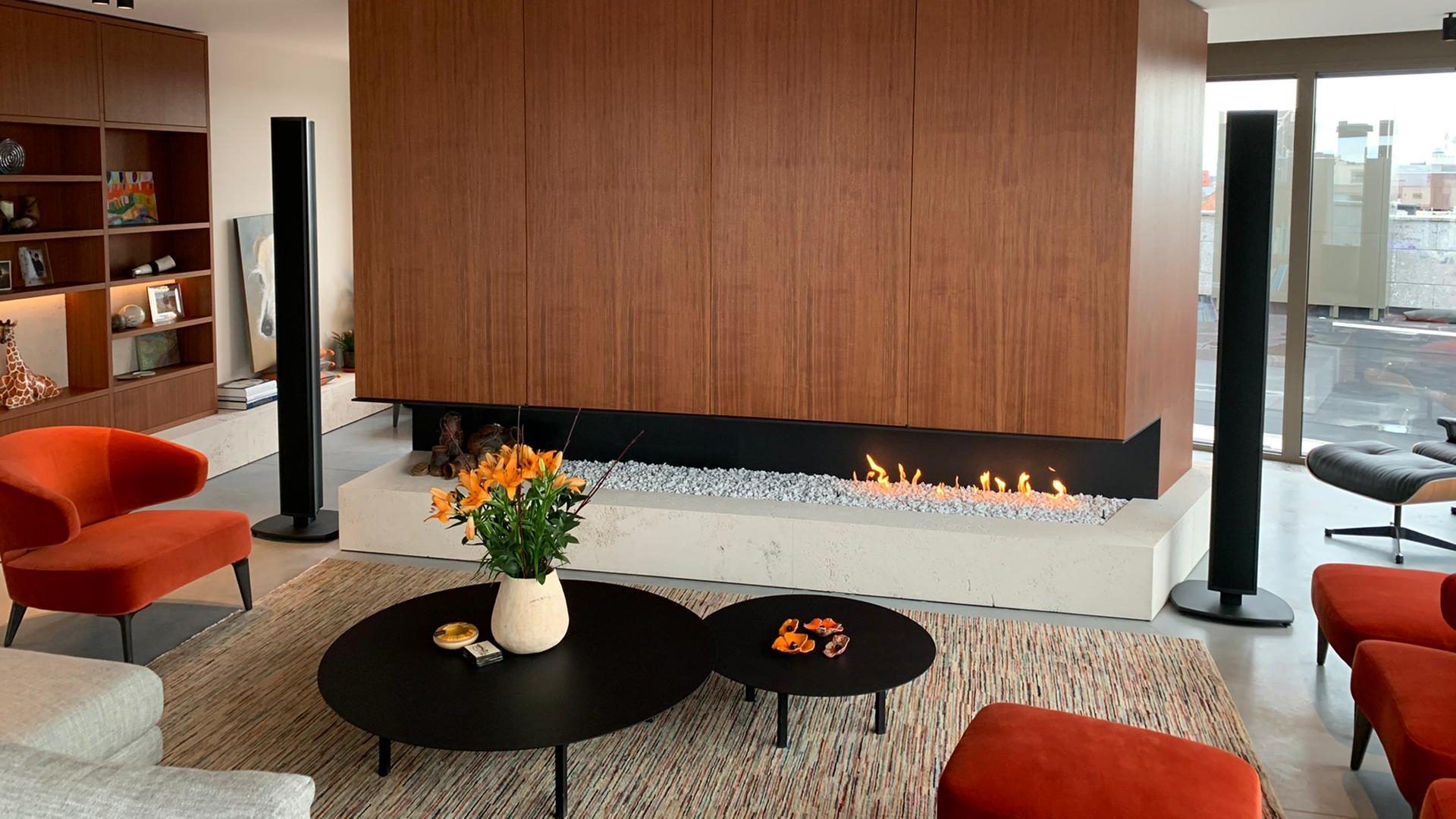
Making a home theater a great room for music
By Adam Zell, Boston Automations | Published | Updated | 6 minute read
The short answer
Can a home theater sound good for stereo music?
Yes. A well designed theater has excellent front speakers, controlled acoustics and calibrated subwoofers, which is everything a music room needs. The key is a dedicated music setup in the processor: a stereo preset using the front speakers and subwoofers, room correction tuned for music, and the option to upmix across the room when you want to.
Why a theater can be a great music room
Think about what a serious music room needs: excellent speakers, controlled reflections, low background noise, deep and even bass, and a comfortable seat in the right place. A properly designed private cinema has every one of those. The acoustic treatment that makes dialogue clear also makes a piano sound real. The subwoofers that handle explosions also handle a pipe organ.
The difference is setup. A theater configured only for films will play music, but not as well as it could.
Where music and film differ
| Consideration | Films | Stereo music |
|---|---|---|
| Speakers in use | Every speaker in the layout | Left and right, with subwoofers |
| Listening area | Every seat in every row | Often one or two prime seats |
| Bass balance | Even across the room, with headroom for effects | Natural and tight, blended invisibly with the mains |
| Center image | A physical center speaker | A phantom image between left and right |
The phantom center is the important one. In stereo, a singer appears between the left and right speakers because both play her equally. That only works if the left and right speakers are well matched, well placed and heard from a seat near the center line.
A dedicated music preset
We build a separate preset for stereo listening in the processor. It usually includes:
- Left and right speakers with the subwoofers, and no other channels
- Room correction measured around the prime music seats, rather than the whole room
- A target curve tuned for music, which is often slightly different from films
- Crossover settings chosen for the front speakers' own bass ability
- A volume range suited to music, without film headroom offsets
One button on the control system selects it. Another selects films. Nobody has to remember settings.
Listening levels for music
Most people play music well below film reference level. A preset that remembers a comfortable starting volume avoids the jolt of a loud track after a film, and a lower level also changes how the bass should be balanced, because our hearing is less sensitive to low frequencies at quiet levels. We set the music preset's target curve with that in mind, so an album at dinner volume still has a full, natural low end. Our guide to how loud a home theater should be covers levels in more depth.
Blending subwoofers for music
Music is where poor subwoofer integration is easiest to hear. A bass line that seems to come from the corner, or a kick drum that lags the rest of the kit, gives the subwoofer away. Careful crossover, timing and phase alignment, and Dirac Bass Control across several matched subwoofers, make the bass sound like it belongs to the main speakers. Our subwoofer integration guide covers how.
Front speakers with strong bass of their own can sometimes run with a lower crossover for music, leaving the subwoofers to fill only the deepest octave.
Seating for music
Films are designed for every seat. Stereo music is at its best in a seat on the center line, roughly the same distance from the left and right speakers. In most theaters, the center seat of the main row is the natural music seat. Some rooms add a seat position, or a chaise, that sits a little further back for music, where the speakers blend more fully.
When we design a room where music matters, we plan the main row so its center seat works for both: at the right distance from the screen for films, and well placed between the left and right speakers for stereo. CinemaTech's drawings set the rows, and the speaker positions follow.
Recliners help here too. A high back seat with an adjustable headrest puts your ears at a consistent height, which keeps the stereo image stable from song to song. Our guide to choosing theater seating covers headrests and motion.
Stereo or upmixed?
Processors can spread stereo recordings across the whole room. StormAudio processors include Auro-Matic, which creates an Auro-3D style presentation from stereo, along with Dolby and DTS upmixers. Some listeners enjoy the sense of space, especially with live recordings and choral music. Others prefer stereo exactly as it was mixed.
There is no wrong answer. We set up both and let you choose by recording. Native immersive music, including albums released in Dolby Atmos and Auro-3D, needs no upmixing at all. Our immersive formats guide explains the differences.
The room for music
Speaker choice matters most at the front. Planar line sources such as Wisdom Audio's Sage Series are especially good for music, because they combine very low distortion with even coverage. Our planar speaker guide explains why.
Treatment matters too. Rooms designed only for film can be slightly drier than ideal for music. With CinemaTech's Acoustic Room System we balance absorption and diffusion so the room is controlled for film without sounding dead for music. See acoustics.
Sources and control
Most music arrives by streaming in lossless or high resolution formats, through a dedicated streamer connected to the processor. Vinyl, CD and high resolution downloads all have a place as well. The control system brings them together, so choosing an album is as easy as choosing a film. For films, our Kaleidescape and madVR page covers lossless movie playback.
Finally, give it time. A theater that plays music this well can be used far more often, for an album after dinner as much as a film on Saturday night. A room that does both well earns its place in the house. It is also the best way to judge a system: music you know well reveals problems in tone, timing and bass faster than any film, which is why we use it during calibration. If music is a priority, tell us early, because it shapes the speaker choice, the treatment and the seating plan from the first drawing.
More questions
Should music bypass the processor entirely?
Some audiophiles route a separate stereo path around the processor. With a high quality processor, we usually keep music inside it, because room correction and subwoofer integration make a bigger difference in most rooms than removing one component from the chain.
Can we listen to vinyl in the theater?
Yes. A turntable and phono stage connect to the processor's analog inputs, or to a dedicated stereo preamplifier if you prefer an all analog path. We plan a vibration free location for the turntable, away from the subwoofers.
Is Dolby Atmos Music worth it in a theater?
Many albums are now released in Dolby Atmos, and in a calibrated theater with real overhead speakers they can sound remarkable. They are a different experience from stereo, and having both available is the ideal.
