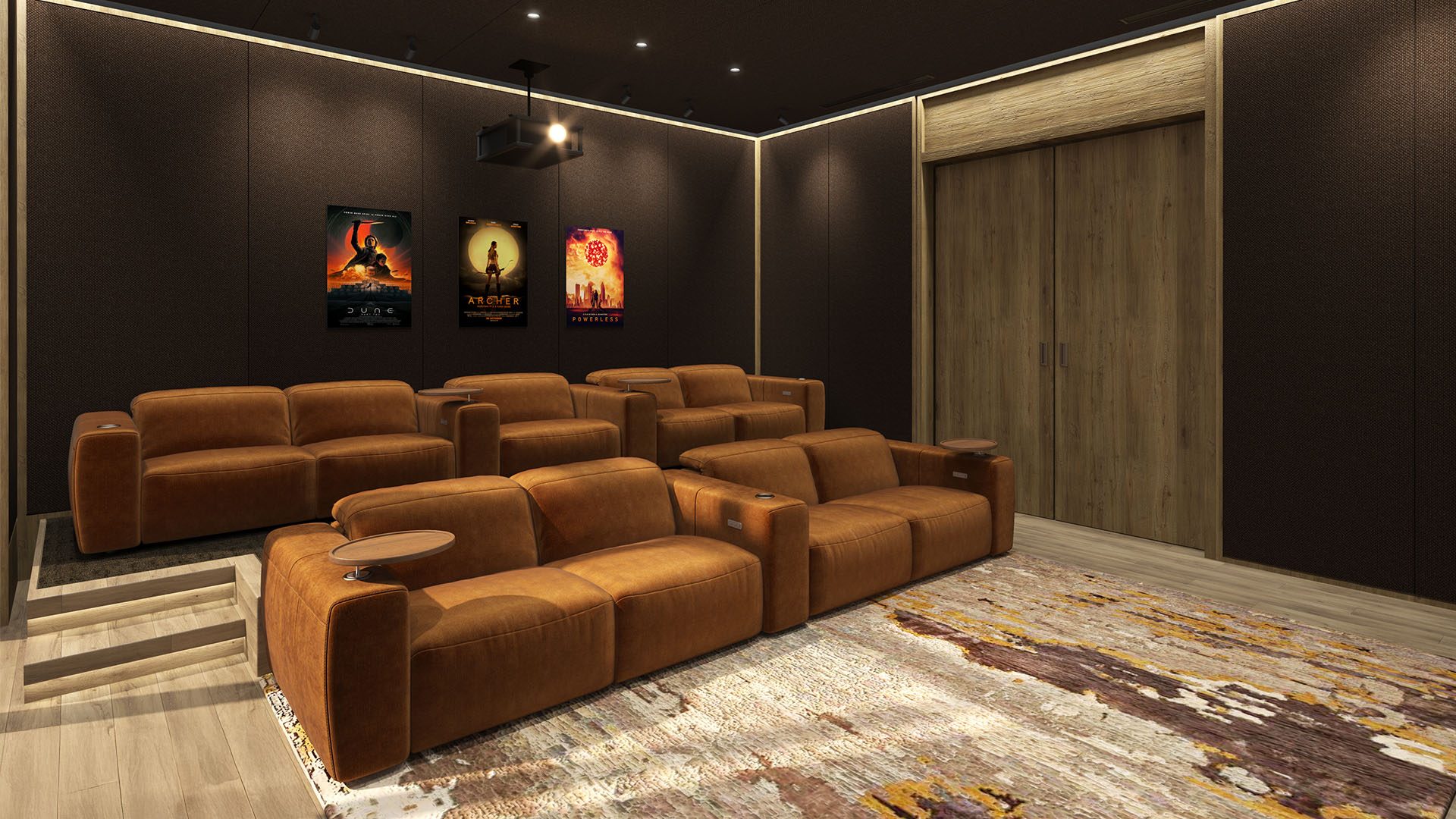
A screening room for a serious film collector
By Adam Zell, Boston Automations | Published | Updated | 7 minute read
The short answer
How is a screening room different from a home theater?
A screening room is built around the film rather than the party. It favors a wide constant image height screen with masking so every aspect ratio looks right, careful sightlines for a small number of prime seats, a reference playback chain for discs and downloads, and storage for the collection. The room is quieter and darker, and the details are tuned for watching closely.
What makes a screening room different
A family theater is built for comfort and fun. A screening room is built for the film. It belongs to someone who notices whether a scope film is cropped, who knows which release of a classic has the better transfer, and who wants the room to disappear the moment the lights go down.
The technology overlaps with any luxury theater. The priorities do not. A screening room puts accuracy, framing, quiet and sightlines ahead of capacity and features. It is often smaller, darker and more restrained.
Aspect ratios and the screen
Films are made in many shapes. Most modern features are either flat, at 1.85:1, or scope, at about 2.39:1. Classic films may be 1.37:1 academy ratio, and some recent releases switch ratios within the film. A standard 16:9 screen handles none of these perfectly.
| Screen approach | How it behaves | Suits |
|---|---|---|
| Constant image height (2.35 to 2.40 screen) | Every film is the same height; scope fills the width, narrower films get side masking | Collectors who watch many scope films |
| Constant width (16:9 or 1.85 screen) | Every film is the same width; scope films get bars top and bottom | Collections weighted to flat and classic films |
| Constant area | A compromise screen where each ratio shares a similar area | Rooms that want neither format to dominate |
Constant image height mimics how many commercial cinemas present films, which is why serious collectors often prefer it. It needs a projector that can zoom and store lens positions, or an anamorphic lens, and a room wide enough for the screen.
Masking
Masking is the black border that frames the image. On a screen without it, letterbox and pillarbox bars are dark gray, not black, and the eye notices. Motorized masking moves black panels or curtains to the edge of each film, so the picture always sits in a crisp black frame.
In a screening room, masking can be tied to the playback system, so it moves to the right position when a film starts. A movie server that knows each title's aspect ratio makes this automatic. Our Kaleidescape and madVR page covers the playback and processing side.
Projector, lens and screen surface
On a wide screen, the projector has to work harder. A constant height room asks it to fill a 2.39:1 screen at full brightness and then shrink the image for narrower films, either by zooming to stored lens positions or with an anamorphic lens. Lens quality, contrast and black level matter more here than in a family room, because collectors watch many dark, carefully graded films.
The screen surface is part of the picture. Acoustically transparent screens let the front speakers sit behind the image, the way they do in a commercial cinema, but the weave or perforation has to suit the seating distance so it stays invisible. Our projector and screen guide covers these choices.
Seating for a screening room
A party theater wants many seats. A screening room wants a few excellent ones. Often the plan centers on two to four primary seats at the ideal distance and on the center line, where the image, the sound and the masking all line up. A second row on a riser serves guests.
Seats should support an upright, attentive position as well as a recline, and they should be silent. Our seating guide and room size guide cover distance and sightlines.
Sources for a collection
A collector's library is rarely in one place. It may include 4K Ultra HD discs, Blu-rays, downloads purchased at high quality, streaming services and sometimes older formats. The playback chain should handle each one well:
- A movie server for purchased films at high quality, with cover art browsing and automatic aspect ratio data
- A high quality disc player for physical media, including special editions that never appear online
- Streaming players for current releases and archives
- Video processing to tone map HDR and scale older material well on a large screen
Frame rate deserves the same care as resolution. Films are shot at 24 frames per second, and every device in the chain should pass 24p through untouched, so the display shows each frame for an equal time instead of converting to 60 Hz and adding a slight judder to slow pans. Motion smoothing should stay off for film. Older titles with mono soundtracks are best played from the center channel alone, as they were heard in the cinema, rather than spread across every speaker by an upmixer.
Every source should be calibrated, and the room should be measured as described in our calibration guide.
The library and archive
Collectors often want the collection to be part of the room or the space just outside it: shelving for discs and box sets, a display wall for posters or lobby cards, and in some homes a separate archive.
Physical media, posters and especially film prints prefer a stable, cool and dry environment out of sunlight. If you keep film prints, ask an archival specialist for storage guidance specific to your collection. We plan shelving and lighting with your architect so the display does not leak light into the screening room.
Details collectors notice
- Black, non reflective surfaces near the screen, so light from the image does not bounce back and wash out contrast.
- A truly quiet room. Isolation, quiet HVAC and a projector in a hush box or rear enclosure keep the noise floor low.
- Curtains and an overture. A motorized curtain that opens as the lights dim sets the occasion.
- Correct aspect for every title, with no stretching or cropping.
- Sound mixed for the room. A layout that suits both classic mono and stereo films and modern Atmos mixes.
If you are building a room for a collection, read what reference means, then tell us about your library.
More questions
Should a screening room use constant height or constant width?
For most collectors, constant image height with a wide 2.35 to 2.40 screen is the better choice, because scope films become the largest image and flat films are framed by side masking. If you mostly watch 1.85 and older academy ratio films, constant width can make more sense.
Can a screening room show 35mm film?
It can be planned for, but a film projector brings its own requirements: a booth with a port, ventilation, platter or reel space, and a projectionist's knowledge. Most private screening rooms today are digital, with the room designed so a film projector could be added later.
