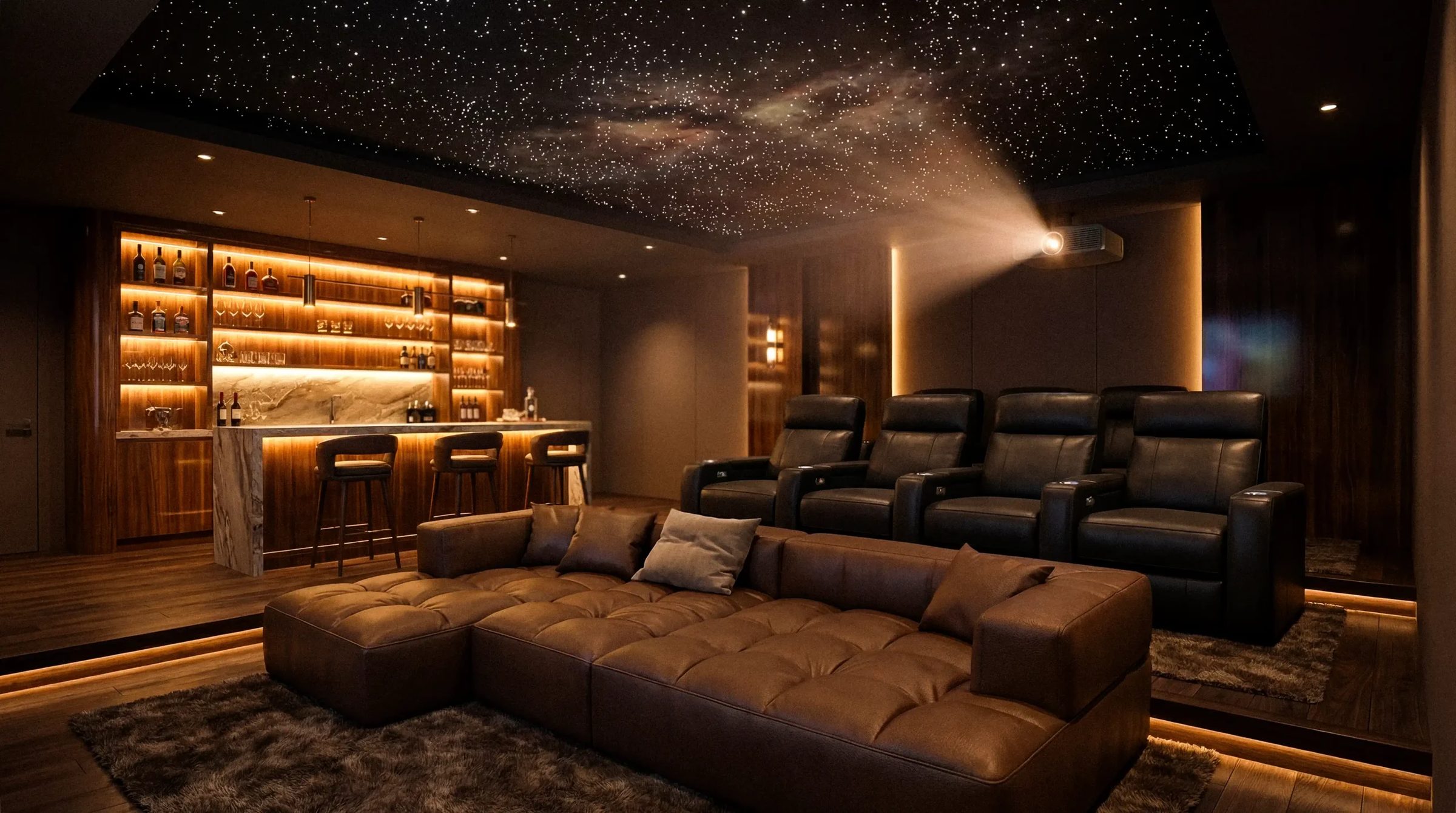
A wine cellar, bar and cinema suite
By Adam Zell, Boston Automations | Published | Updated | 6 minute read
The short answer
Can a wine cellar be next to a home theater?
Yes, and it is a natural pairing. The cellar needs its own cooling and humidity, around 55 degrees and 50 to 70 percent relative humidity, separate from the theater's air. The shared wall should be insulated and sealed so the cellar stays cool and the theater stays quiet. A bar or lounge between them gives guests a place to gather before and after the film.
Why these rooms belong together
A dinner party moves. Guests arrive and gather at the bar, someone opens a bottle from the cellar, and later the group settles into the theater for a film or a game. When the cellar, the bar and the cinema are planned as one suite, that evening flows from room to room without anyone climbing stairs.
These rooms also share practical needs. All three are often on the lower level, where it is naturally cooler and darker. All three benefit from careful lighting and good control. The trick is that the cellar and the theater want very different climates and need to be kept apart in the right ways.
Laying out the suite
The bar or lounge is usually the hub, with the cellar on one side and the theater on the other. A few principles help:
- Guests should reach the bar without walking through the theater.
- The cellar is a showpiece. A glass wall or door facing the lounge lets it be seen without opening it.
- The theater entrance should be off the lounge, with a short vestibule or a solid sealed door to keep sound and light in.
- Restrooms and a path to the kitchen or a service stair should be close.
- If there is a golf simulator or game room, it can share the lounge as well. See our simulator and game room guide.
Cellar and theater climates
| Room | Temperature | Humidity | Main concern |
|---|---|---|---|
| Wine cellar | About 55°F, held steady | Roughly 50 to 70 percent | Stability for long term aging |
| Bar and lounge | Normal living comfort | Normal living range | Fresh air for a crowd |
| Theater | Comfortable for a full room over a long film | Below about 50 percent where possible | Quiet air, heat from people and equipment |
Wine storage guidance from cellar specialists commonly cites about 55°F and 50 to 70 percent relative humidity, with stability mattering more than any single number. That is far cooler and more humid than a theater should be. The EPA recommends indoor humidity below 60 percent and ideally 30 to 50 percent for living spaces, which protects upholstery, acoustic fabric and electronics.
So the cellar needs its own dedicated cooling system, designed by a cellar specialist, and the theater needs quiet, well dehumidified air from the house system or its own unit. The cellar's condenser and the theater's air handler both make noise, so their locations and duct paths are planned to stay out of the theater.
The shared wall
Where the cellar meets a warmer room, the wall has to do two jobs: hold the cellar's cool, humid air in and keep moisture from condensing inside the wall. Cellar specialists specify insulation and a vapor barrier on the warm side for this reason, and the details depend on the assembly, so follow their design.
If the cellar shares a wall directly with the theater, sound becomes the second concern. The theater side should be built with its own isolated framing, so bass is not carried into the cellar structure and the cellar equipment is not heard during a quiet scene. Our guide to acoustics and soundproofing explains decoupled walls.
Wine storage guidance also warns against constant vibration and strong light, both of which a theater produces. Keep subwoofers off the shared wall and away from the racks, and do not fasten speakers or equipment to framing that also carries the cellar. On the cellar side, LED lighting on a dimmer and glass with UV protection keep the display bottles out of harsh light while still letting guests see them from the lounge.
The bar and lounge
The bar is where the suite lives most of the time. It usually includes a sink, an ice maker, under counter refrigeration and a dishwasher drawer, all of which need plumbing and drainage on the lower level. Ice makers and refrigerators hum, so placing them away from the theater wall keeps the cinema quiet.
A large display over or near the bar lets people follow a game while they talk. Some theaters also add a bar counter at the back of the cinema itself, on a riser behind the last row, so guests can sit high and still see the screen. It needs its own lighting, so the counter stays usable without spilling light toward the screen.
Light and sound across the suite
Lighting ties the rooms together. The cellar is lit like a gallery, with low heat LED on the racks and a feature wall. The bar has pendants and under counter light. The theater has its own layered scenes. A Welcome scene can light all three for arriving guests, then a Movie scene darkens the theater while leaving the lounge softly lit for anyone stepping out.
Music runs through the bar and lounge as its own zone, separate from the theater. When a film starts, the lounge music can drop automatically. Our guide to theater lighting design covers the scenes.
A planning checklist
- Decide the order of rooms and how guests arrive.
- Engage a wine cellar specialist early for the cooling system, walls and racking.
- Give the theater its own quiet, dehumidified air, separate from the cellar.
- Isolate the theater from the cellar and from bar equipment noise.
- Plan plumbing and drainage for the bar on the lower level.
- Coordinate lighting and audio zones across all three rooms.
- Put the whole suite on one control system with scenes for arrival, film and closing.
These suites often sit on the lower level, so our basement theater guide is a good next read. When you are ready, tell us how you entertain.
More questions
Can a wine cellar have a glass wall facing the theater lounge?
Yes, and it is a popular choice. The glass should be insulated, usually double or triple glazed, and sealed into its frame so the cellar holds its temperature and humidity. Lighting inside the cellar should be low heat LED and on its own control.
Will subwoofers disturb the wine?
Collectors are cautious about vibration for long term storage. Keep subwoofers away from the shared wall, isolate the theater construction from the cellar, and mount racks on the cellar's own structure rather than on a wall the theater shares.
